






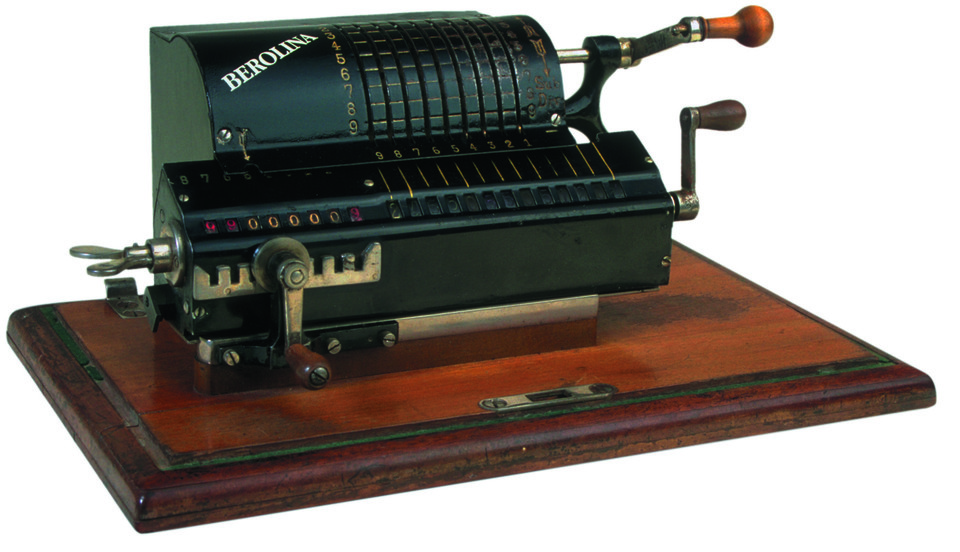
Berolina
Vierspezies-Sprossenradmaschine
ca. 1901
Berolina
Four-species pinwheel machine
ca. 1901
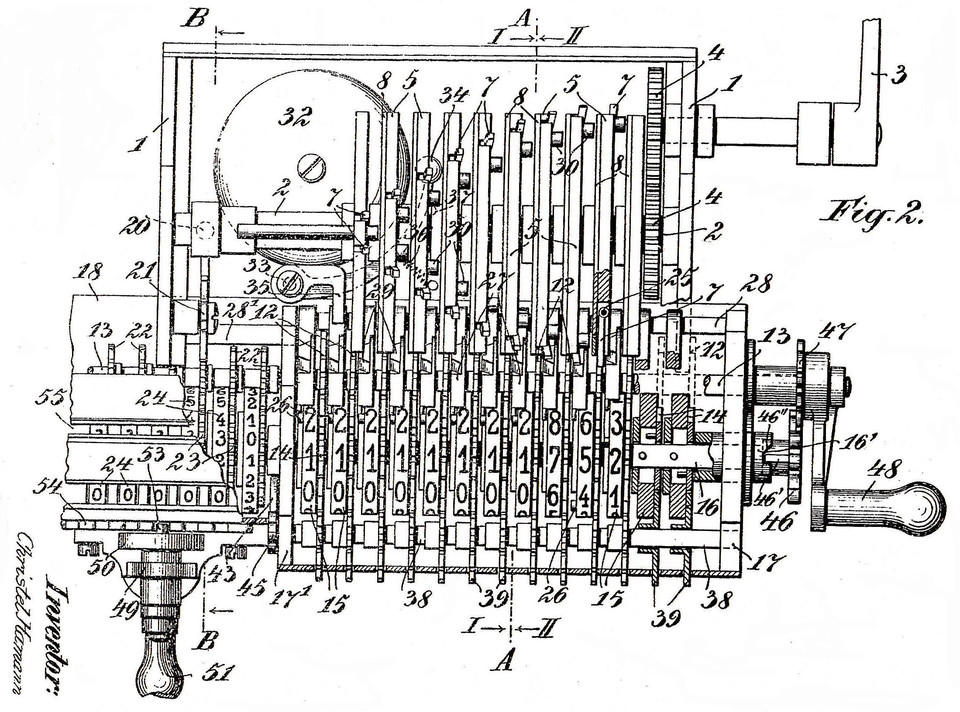
About ten years after the start of production at Brunsviga (1892), Ernst Schuster, Berlin, was able to launch this four-species calculating machine on the market. It was thus the fourth pinwheel machine manufactured in Germany; the second was by Heinrich Esser (see FDM 6581) and the third by W. Küttner (FDM 9019). Christel Hamann is referred as the plausible inventor in literature. He is said to have designed and manufactured it around 1898 in his Berlin precision engineering institute. Afterwards he transferred the distribution to Ernst Schuster. Between 1901 and 1908 several patents were then issued to Schuster, which concerned individual improvements and additions to pinwheel machines. The proof of Hamann's authorship of the Berolina, also with a second result work, exists in two US patent specifications: US 705838 and US 772935, in which all specific devices of the Berolina are described. The Berolina was a very early competitor of the Brunsviga, especially in foreign business, where it was offered as Multo-Divo (see FDM 9007), as Svecia or as BIS.
The machine was of simple design, without safety devices to prevent operating errors, and it differed from the Brunsviga only in the cranks for carriage movement and for counter resetting. Another model "Duplicator" contained a second result unit so that it was possible to make sums of products, a common requirement in the technical and statistical field. This addition was also patented by Christel Hamann/Ernst Schuster. Around 1927 the production of the machines was stopped.
Ernst Schuster was the general representative of the Brunsviga company in Berlin for several years (approx. 1895 to approx. 1908), and then competed with his Berolina against the former supplier. It is reported that this machine was not only designed by Christel Hamann, but also manufactured in his mathematical-mechanical institute in Berlin-Friedenau until the 1920s. According to these accounts, Schuster was only responsible for sales. The last certainty for these circumstances has not been found yet. This specimen differs from the older FDM 6367 machine: it has no direct setting in the resulting movement.
- Inventory number:
- FDM6301
- Year of invention:
- 1901
- Manufacturer:
- Ch. Hamann Mathematisch-mechanisches Institut (GmbH)
- Year of manufacture:
- ca. 1901
- Main category:
- Vierspeziesmaschine
- Subcategories:
- Sprossenrad
- Capacity:
- 9 (EW) x 8 (UZW) x 13 (RW)
- Dimensions (H x B x T):
- 14 x 38 x 20 cm
- Weight:
- 9,3 kg
- Production period:
- 1901 - 1929
- Serial number:
- 93 (?)
- Literature:
- Anthes, Erhard: „Grundpatent von Christel Hamann - Die Rechenmaschine Berolina.'' in: Historische Bürowelt 84, 2011, p. 26-27
- Brauner, Ludwig/Vogt, Victor: Illustriertes Orga-Handbuch erprobter Büro-Maschinen. Berlin 1921, p. 222
- Handbuch der Büromaschinen: Übersicht über die wichtigsten auf dem mitteleuropäischen Markte eingeführten Büromaschinen und Apparate. Berlin o. J. [1927], p. 149
- Martin, Ernst (Pseud.): Die Rechenmaschinen und ihre Entwicklungsgeschichte. Pappenheim 1925, Nachtrag 1936 (Nachdruck: Leopoldshöhe 1985), p. 138f.
- Petzold, Hartmut: Rechnende Maschinen. Eine historische Untersuchung ihrer Herstellung und Anwendung vom Kaiserreich bis zur Bundesrepublik. Düsseldorf 1985, p. 130
- Reese, Martin: Neue Blicke auf alte Maschinen. Zur Geschichte mechanischer Rechenmaschinen. Hamburg 2002, p. 53-54
- Patents:
- AT 17165 [1902] (Ernst Schuster: Rechenmaschine)
- DE 143884 [1902] (Ernst Schuster: Vorrichtung zum Einstellen der einzelnen Zifferräder an Rechenmaschinen mit Schaltzähnen)
- DE 204040 [1907] (Ernst Schuster: Einrichtung an Rechenmaschinen o. dgl. mit mehreren, in der gleichen Achsenrichtung nebeneinanderliegenden Zähl- oder Anzeigewerken zum [...])
- DE 205794 [1907] (Ernst Schuster: Sperrvorrichtung zur Sicherung der Stellscheiben an Rechenmaschinen mit Antriebrädern von einstellbarer Zähnezahl)
- GB 190209797 [1902]
- US 705838 [1902] (C. Hamann: Calculating Machine)
- US 772935 [1903] (C. Hamann: Calculating Machine)
- US 901748 [1908] (E. Schuster: Calculating Machine)
- Further exemplars in the collection (1):