






Braun / Vayringe (Villingen-Schwenningen) (Replica)
Zylindrische Vierspezies-Stellsegmentmaschine
1727
Braun (replica): cylindrical four-species machine
1727
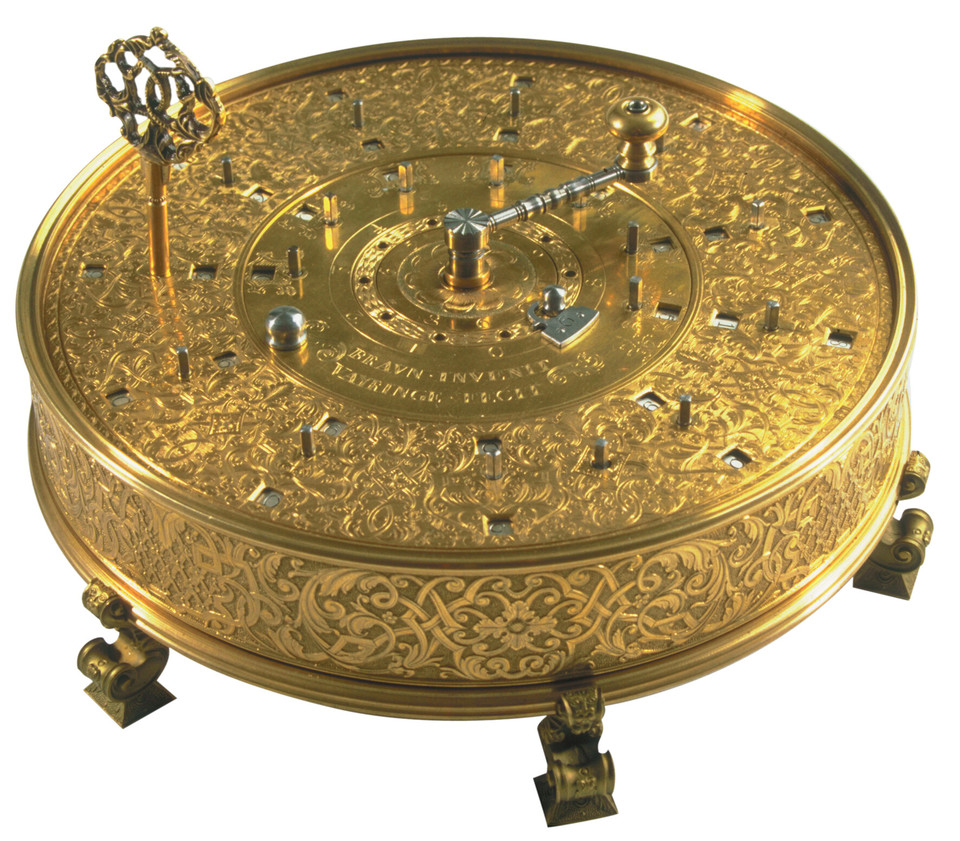
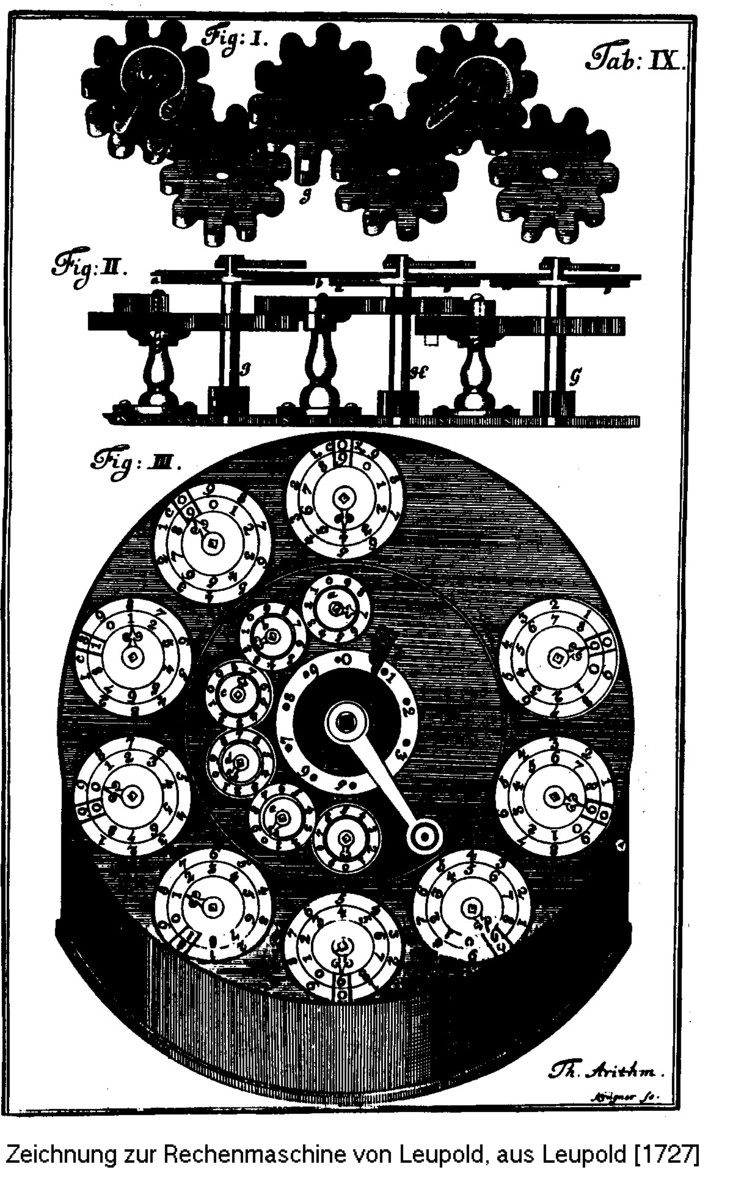
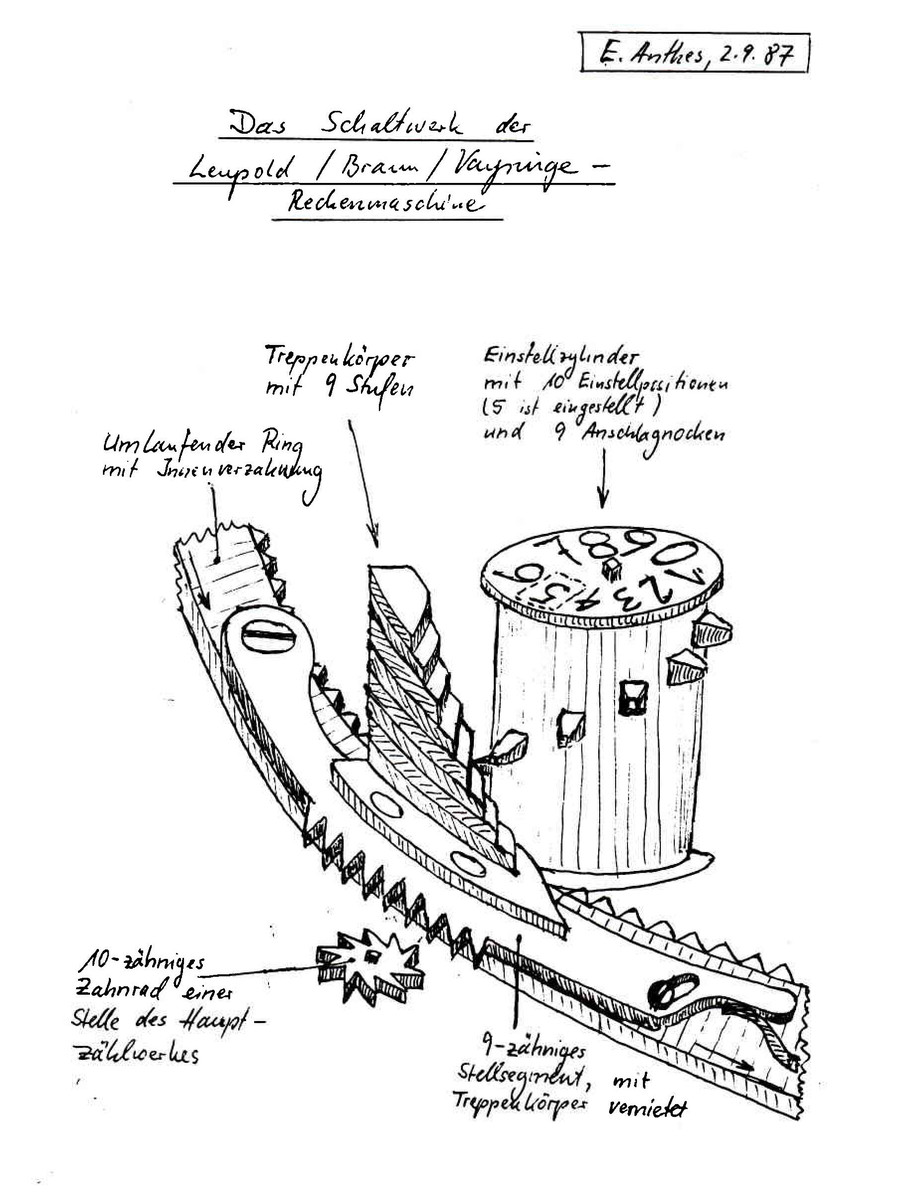
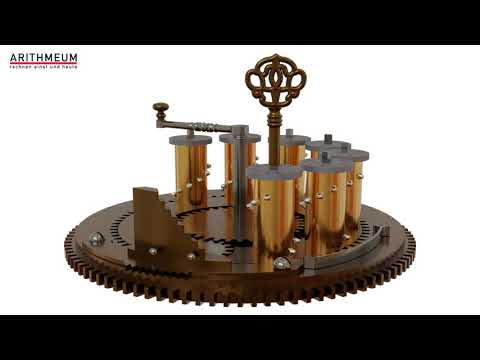
The Viennese court optic and mathematician Anton Braun (1686 – 1728) built a large circular and palatial reckoning machine in 1727 as a masterpiece for Emperor Charles VI. Its function corresponded to that of a pin wheel mechanism of the Poleni reckoning machine. Except for the weight impulse, which Braun replaced with a hand crank, the mechanical structure was very similar. Poleni is said to have burned his calculating machine when he became aware of Braun’s magnificent piece of work. It is not certain yet, when Braun started working on his second, much smaller calculating machine. The question of the extent to which Philippe Vayringe (1684 – 1746), a watchmaker and mechanic from Lorraine, who was noted on the cover plate of the machine, was involved in the invention or realization could not be answered yet. It is interesting, however, that this machine bears great similarities to a design of a calculating machine that Jacob Leupold published in 177 in his book “Theatrum Arithmeticum” and called his own, even though the lid of Braun’s machine obviously suggests an earlier year for the manufacture. Despite these open questions, it can be said that this smaller Braun has a fascinating mechanism. The original came from a private ownership in Vienna to the German Museum in Munich in 1925 and is still on display there today. Instead of several in wheels or stepped drums, it has a single central control segment. With this idea, the number of complex manufactured special components in the reckoning machine could be reduced a lot. Under the setting mechanism, standing cylinders are arranged. 9 pins outstand from these at different heights. For example, if the number 9 is set, the lowest pin is turned externally. When the crank turns, the central control segment is moved once around the central axis. It consists of a stepped stair plate and a tooth segment with nine teeth attached to it. If it is moved past the setting cylinder when the crank is turned, the pins on it press the stair plate externally at the corresponding steps at a certain point. At this moment, the tooth segment engages in a takeover gear of the result mechanism and moves the number of teeth and the numbers of the display window accordingly. With multiple crank turns, this process is repeated and therefore a multiplication is made. A digit-shift is possible in order to count with multi-digit multipliers. Subtraction and division are done by using complementary numbers in the 9th complement. Is a smaller number set, the control segment is pushed into the intrusion of the takeover wheel later than with a larger number. Even if the tens carry does not work properly across all positions yet, this idea of storing numbers with a single central element was very well thought out and was used again in the 20th century , for example, in a similar form in the famous Curta reckoning machine – even if the central element was a stepped drum. The authentic replica in the Arithmeum was built between 1986 and 1996 at the Villingen-Schwenningen precision engineering school together with two other examples. One of them is in the local history museum in Möhringen near Tuttlingen and the second went to the German Museum in Munich together with a plexiglass cover to function as a model.
- Inventory number:
- FDM9340
- Inventor:
- Braun, Anton
- Year of invention:
- 1727
- Replica manufacturer:
- Feintechnikschule Villingen-Schwenningen; Manfred Burkert
- Replica year of manufacture:
- 1996
- Main category:
- Vierspeziesmaschine
- Subcategories:
- Stellsegment
- Capacity:
- 7 (EW) x 1 (UZW) x 11 (RW)
- Dimensions (H, ø):
- 7 cm, ø 20 cm
- Weight:
- 4,0 kg
- Literature:
- www.arithmeum.uni-bonn.de/sammlungen/rechenmaschinen-videos/archiv
- Fischer, Joachim: „Schmuckstücke mechanischer Instrumente & Rechengeräte - Die Rechenmaschine von Anton Braun und Philippe Vayringe“, in: Kultur und Technik 3, 1988, p. 160-163
- Habacher, Maria: „Mathematische Instrumentenmacher, Mechaniker, Optiker und Uhrmacher im Dienste des Kaiserhofes in Wien (1630-1750)”, in: Blätter für Technikgeschichte 22, 1960, p. 4-80
- Janetschek, Hellmut: „Die Mechaniker- und Uhrmacherfamilie Braun und die Braunschen Rechenmaschinen, Ergänzungen und Richtigstellungen zur bisherigen Forschung“, in: Blätter für Technikgeschichte 50, Wien 1988, p. 165-180
- Leupold, Jacob: Theatrum Arithmetico-Geometricum. Leipzig 1927 (Reprint: Hannover 1982), p. 38-41
- Nagler, Josef: „Beschreibung der Rechenmaschine des Antonius Braun“, in: Blätter für Technikgeschichte 22, 1960, p. 81-87