






American Arithmometer
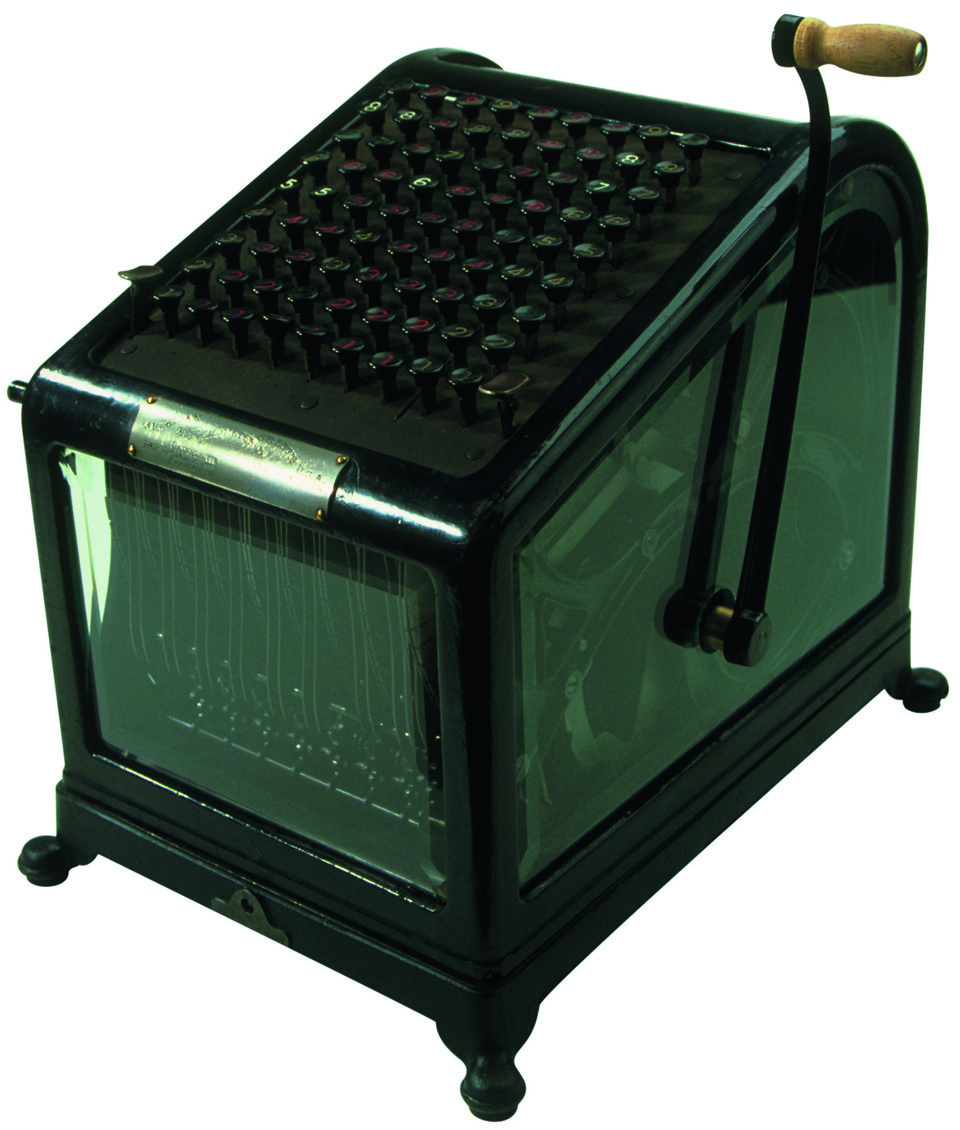
Volltastatur-Addiersegmentmaschine mit Druckwerk
1900
American Arithmometer
Full keyboard adding segment machine with printing unit
1900
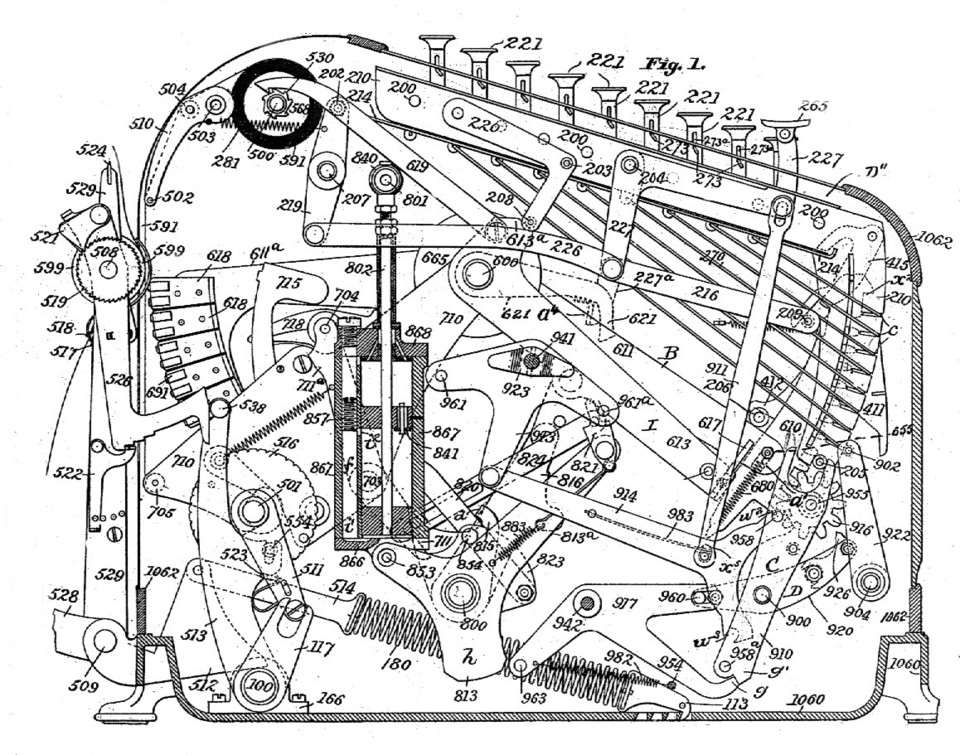
William Seward Burroughs (1857 - 1898) developed a printing adding machine from 1880 onwards, whose transfer element, the adding segment, was an invention that could hardly be improved for most other constructions of printing calculators: Here, the value set in the keyboard is transferred to the summing mechanism when the lever is pulled and printed on a paper strip by means of printing types. The movement of the individual adding segments is limited according to the set digit. The first patent for this invention was applied for in 1885.
In 1886, the American Arithmometer Company was founded in St. Louis, which was renamed Burroughs Adding Machine Company in 1905. In 1907 the 50 000th machine was produced.
The very early machine with the number 5391 was produced around 1898. Only a short time later, the copy with the machine number 7515 (FDM 7286), which is in the Arithmeum, was produced. Both do not yet have the technically sophisticated car of the later models. They document the technical state of the machine at the death of the designer and company founder.
The machine works, but the paper transport is a bit inaccurate or limited sincethe drum is worn out.
- Inventory number:
- FDM9109
- Inventor:
- Burroughs, William Seward
- Year of invention:
- 1885
- Manufacturer:
- American Arithmometer Company
- Year of manufacture:
- 1900
- Main category:
- Ein- bis Dreispeziesmaschine
- Subcategories:
- Addiersegment
- Capacity:
- 9 (EW) x 9 (RW)
- Dimensions (H x B x T):
- 32 x 28 x 42 cm
- Weight:
- 24,8 kg
- Serial number:
- 5391
- Literature:
- The Burroughs Adding and Listing Machine, in: Engineering 83 (1907), p. 580-582
- Erhein, F.: „Eine Additionsmaschine“, in: Illustrierte Zeitung, Nr. 2968, 1900, p. 735
- Horsburgh, E. M.: Handbook of the Napier Tercentenary Celebration or modern Instruments and Methods of Calculation. Los Angeles, San Francisco 1982 (Orig.-Ausg. Edinburgh 1914), p. 91-98
- Kidwell, Peggy A.: „The Adding Machine Fraternity at St. Louis: Creating a Center of Innovation, 1880-1920”, in: Annals of the History of Computing, April-Juni 2000, p. 4-21, p. 8ff.
- Lange, Werner: „Aus einer Idee wurde eine Industrie. Die Entwicklung des Hauses Burroughs“, in: BZB 1061, 1960, p. 51-54
- McCarthy, James H.: The American digest of business machines. Chicago 1924, p. 520
- Turck, J. A. V. [1921]: Origin of Modern Calculating Machines. A Chronicle of the Evolution of the Principles that form the Generic Make-up of the Modern Calculating Machine. Chicago 1921
- Patents:
- DE 50324 [1888] (American Arithmometer Company: Additionsmaschine mit Registrirvorrichtung)
- DE 77068 [1893] (American Arithmometer Company: Additionsmaschine)
- US 388118 [1888] (Burroughs: Calculating Machine)
- US 388119 [1888] (William S. Burroughs: Calculating-Machine)
- US 504963 [1893] (Burroughs: Calculating Machine)