






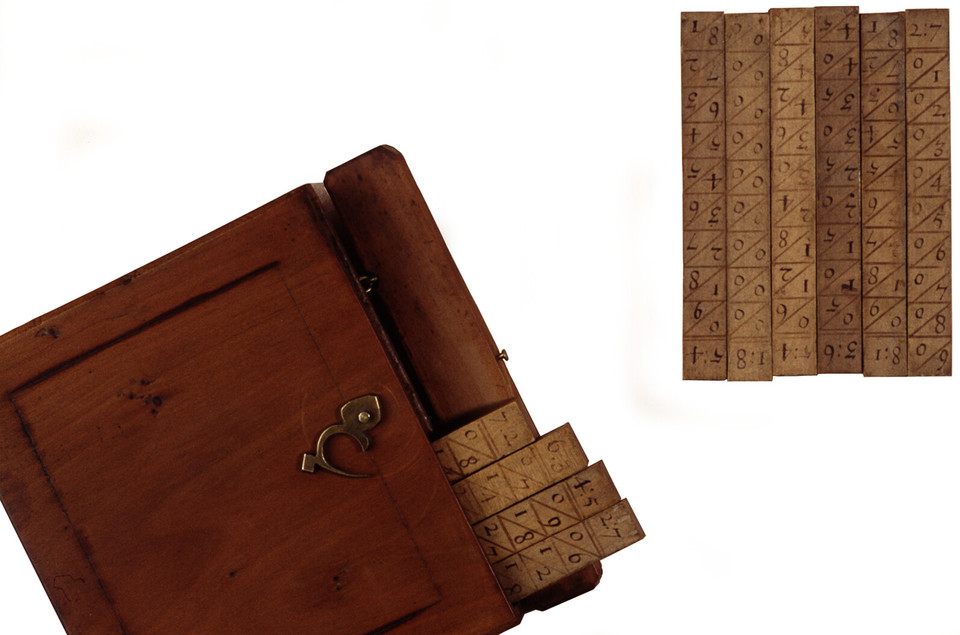
Napier'sche Stäbe
Rechenstäbe für die Multiplikation
ca. 1700
Napier Bones: reckoning rod for multiplications
around 1700
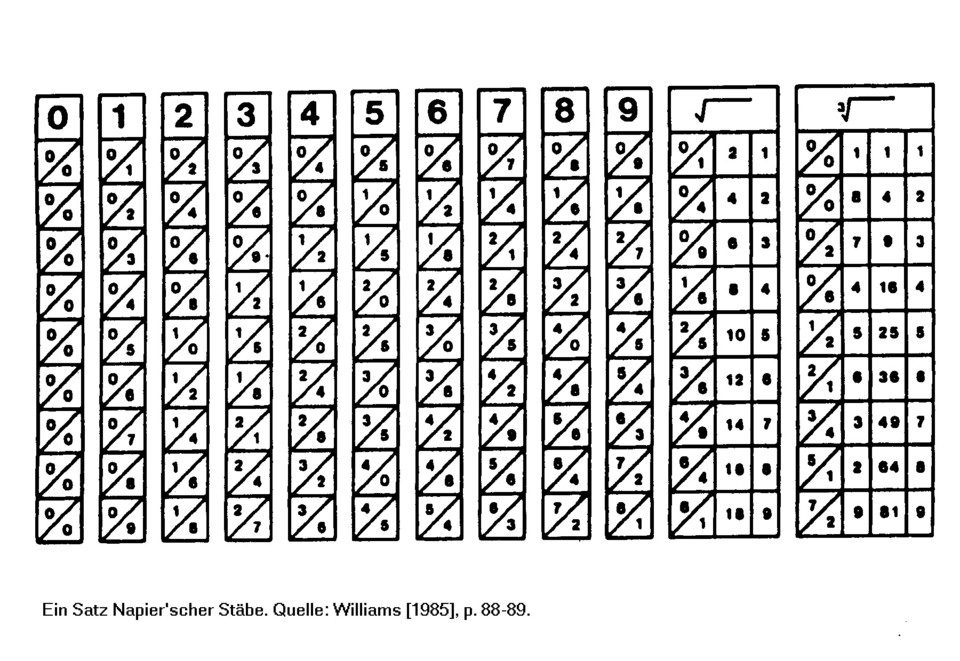
The mathematician John Lord Napier of Merchiston (1550-1617), famous for his work about logarithm, invented this easy multiplication assistance: squared rods each contain a column of the multiplication table on their sides. They can be merged proficiently to read off one-digit multiplications with multi-digit numbers. The tens carry is marked, so that it can be added to the next digit. It was possible to reckon divisions with them as well. Napier Bones had a big significance for the simplification of multiplications and divisions. They were still used intensively in the 19th century, but especially in France (see Genaille Bones). This set is probably originated in England; the wooden casket has a more recent date (19th century) than the rods (around 1700).
- Inventory number:
- FDM8942
- Inventor:
- Napier Lord of Merchiston, John
- Year of invention:
- 1617
- Year of manufacture:
- ca. 1700
- Main category:
- Einfaches Rechenhilfsmittel
- Subcategories:
- Napierstäbe
- Dimensions (H x B x T):
- 2 x 10 x 9 cm
- Weight:
- 86 grams
- Literature:
- Bryden, David J.: Napier´s Bones, A History and Instruction Manual. London 1992
- Weiss, Stephan: Die Rechenstäbe von Neper, ihre Varianten und Nachfolger. Ein Beitrag zur Geschichte des instrumentalen Rechnens. Ergolding 1985
- Williams, Michael R.: A History of Computing Technology. Prentice Hall 1985, p. 88-98