






Roth (Replica)
Zylindrische Vierspeziesmaschine mit Sprossenrädern und Ratschenantrieb
1841
Roth (Replica)
1841
Didier Roth (1800-1885) was born in Cassovia in what was then Hungary as the son of Jewish parents and was given the name David. His father died when he was six years old and his mother had to provide for the family's livelihood. She worked in a kosher restaurant and later enabled her son to study medicine in Vienna. An outbreak of cholera around 1830 caused Roth to leave Vienna. He emigrated to France and lived in Paris from then on, where he practised as a homeopath. Among his patients was the Austrian ambassador, Baron Rothschild.
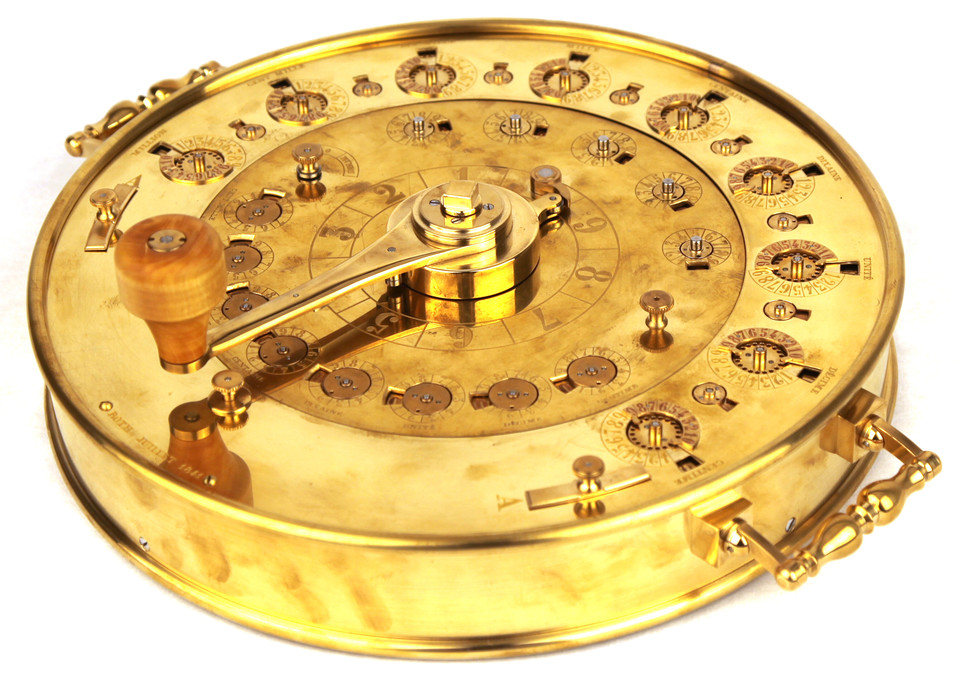
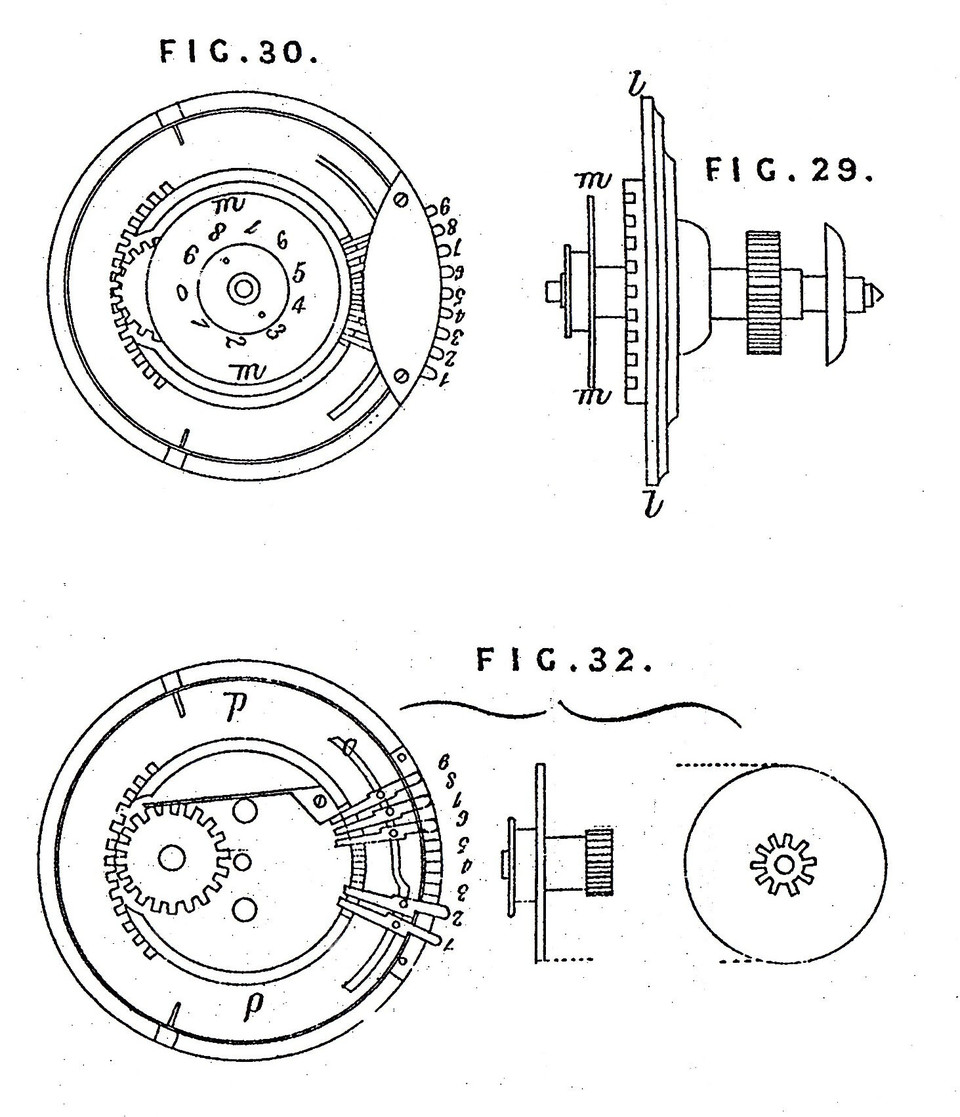
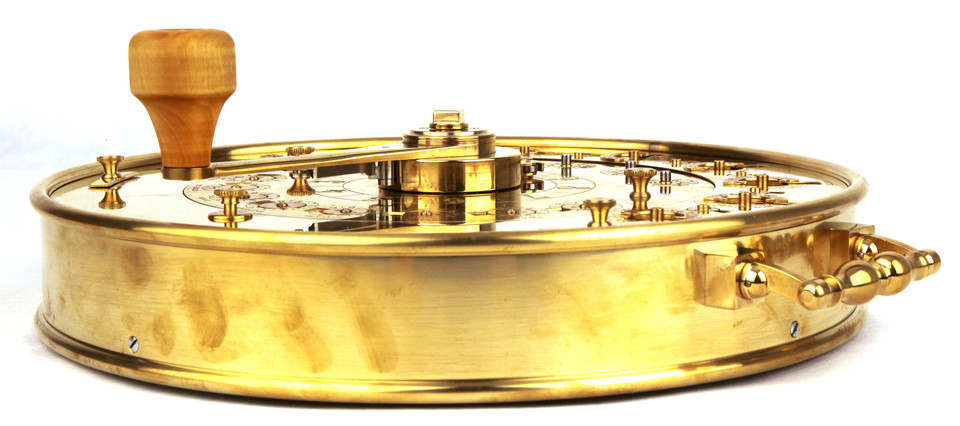
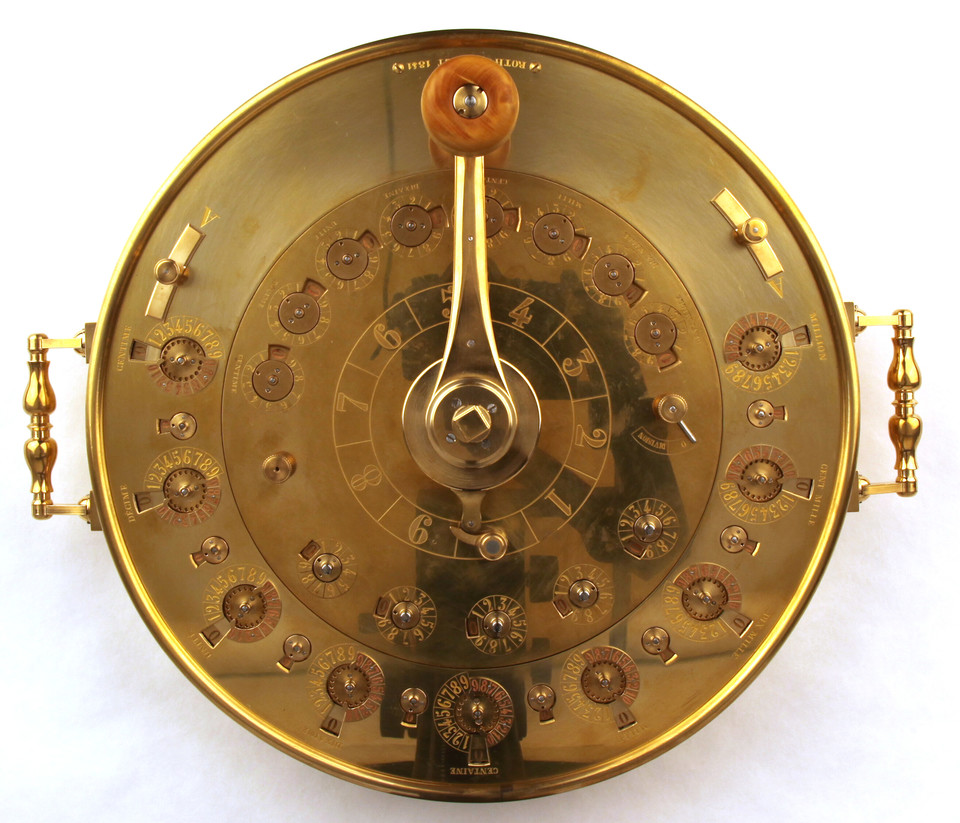
Roth, who had many interests and liked to deal with art, assembled a remarkable collection of Dürer's engravings, some of which are now in the National Library and the Louvre. His most remarkable commitment, however, was to the invention of calculating machines. In addition to extraordinarily intelligently designed adding machines, he also left behind the first automatically multiplying calculating machine. The prototype and the original are now in the Musée des Arts et Métiers in Paris. A replica true to the original was completed for the Arithmeum in 2014. For this purpose, the original machine was first examined, measured and documented in detail. Roth used pinwheels for his calculating machine and was thus able to make his circular construction considerably flatter than Hahn's.
Using a central ratchet, the number is transferred up to nine times from the setting mechanism located in the inner assembly to the result mechanism. To do this, the ratchet must be placed with its pointer on the corresponding number. In the subsequent resetting process, the number is transferred to the result mechanism several times by turning the pinwheels inside the machine. In order to prevent excessive speeds in the mechanics and to avoid overspeeding, Roth installed a wind vane as a brake in the machine. The transfer of tens is quite elementary and takes place via a short rocker between the result unit positions. Roth did not build any further circular calculating machines after that. The replica is fully functional and demonstrates Roth's unique inventive talent very clearly.
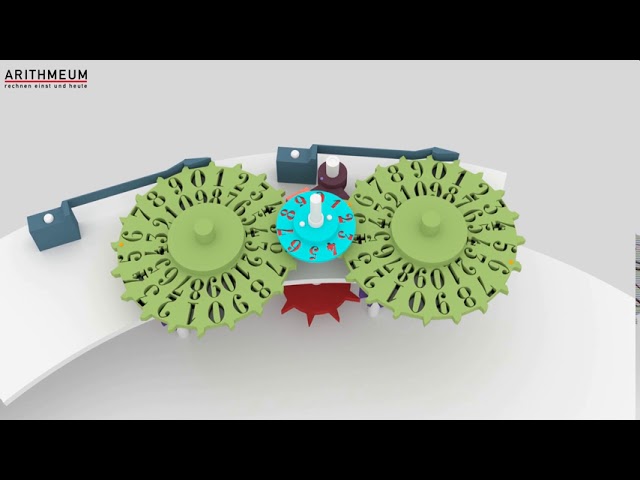
- Inventory number:
- FDM4553
- Inventor:
- Roth, Didier
- Year of invention:
- 1841
- Replica manufacturer:
- Ingo Laubach, Arithmeum; Münchner Mechanikwerkstatt von Ing. Iwanoff
- Replica year of manufacture:
- 2014
- Main category:
- Vierspeziesmaschine
- Subcategories:
- Sprossenrad
- Capacity:
- 5 (EW) x 8 (UZW) x 9 (RW)
- Dimensions (H, ø):
- 11 cm, ø 31 cm
- Weight:
- 9,8 kg
- Literature:
- www.arithmeum.uni-bonn.de/sammlungen/rechenmaschinen-videos/archiv
- Conservatoire Nationale des Arts et Métiers: Instruments et machines à calculer. Ausstellungskatalog Conservatoire National des Arts et Métiers. Paris 1942, p. 59
- Conservatoire National des Arts et Métiers: De la machine de Pascal à l´ordinnateur. Austellungskatalog Conservatoire National des Arts et Métiers. Paris 1990, p. 45, Abb. vor p. 41
- Ocagne, M. de: Le calcul simplifié. Paris 1905, p. 61-62
- Patents:
- GB 9616 [1843] (Wertheimber: Calculating Machines, applicable to Wheel-Work)