






Dietzschold Versuchsmodell
Schaltklinkenmaschine
1876
Dietzschold test model
Switching ratchet machine
1876
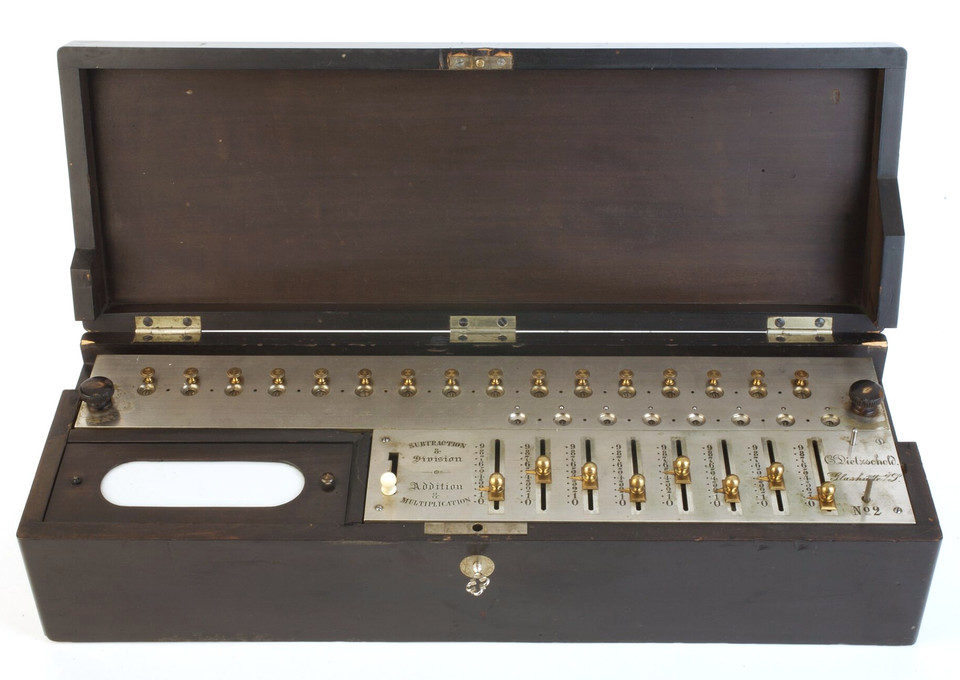
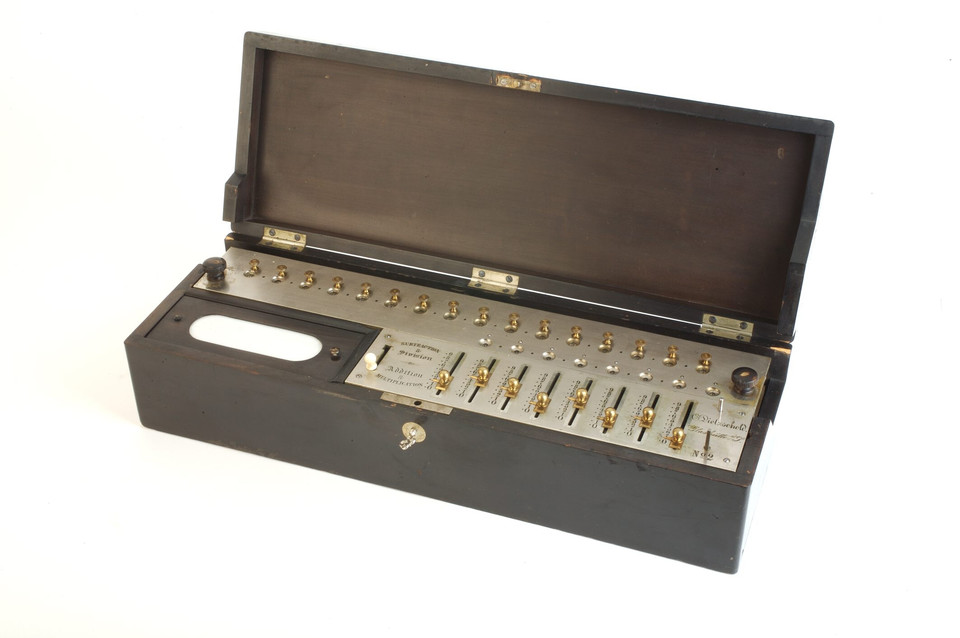
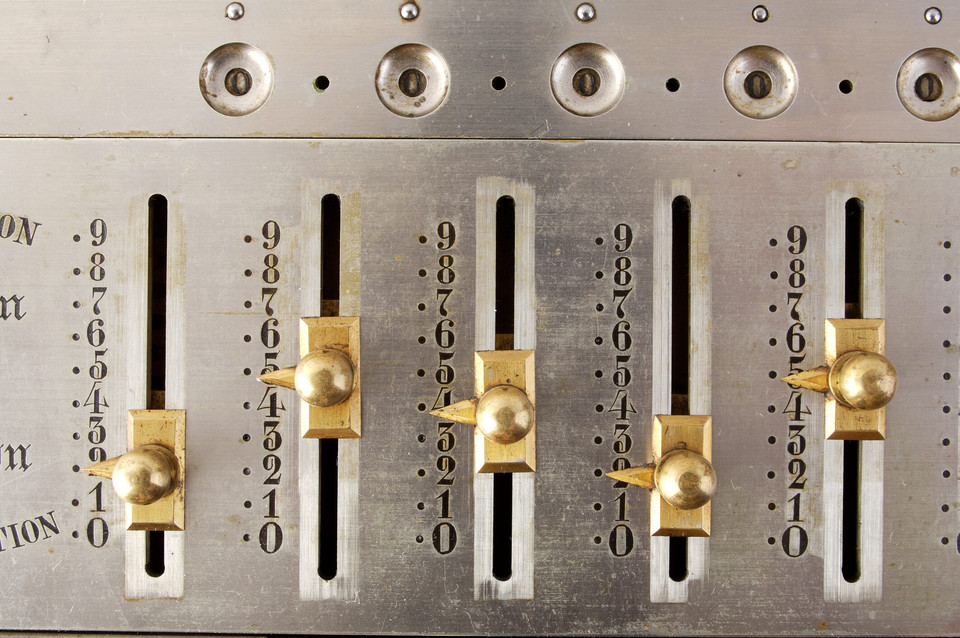
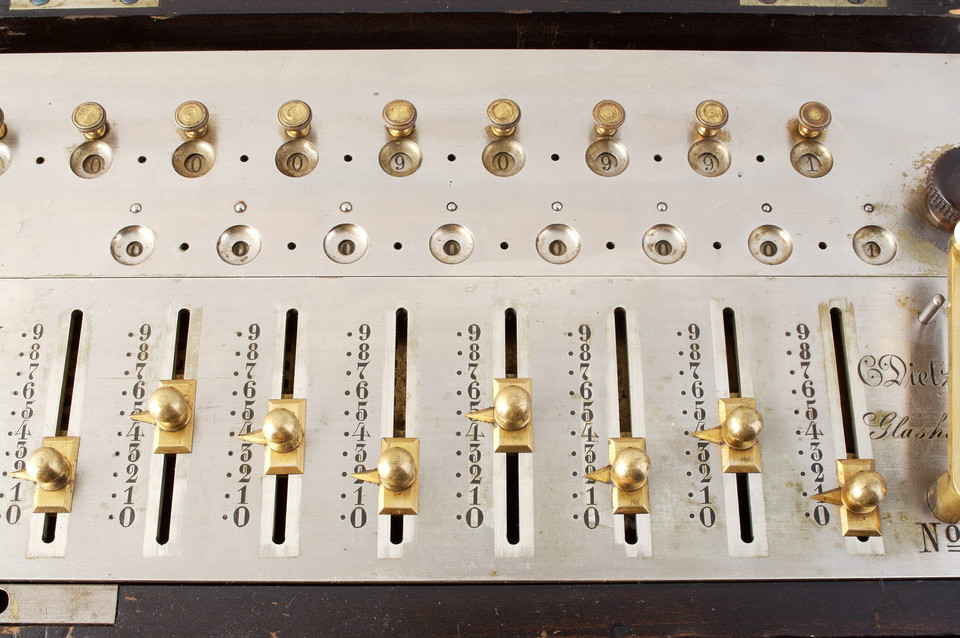
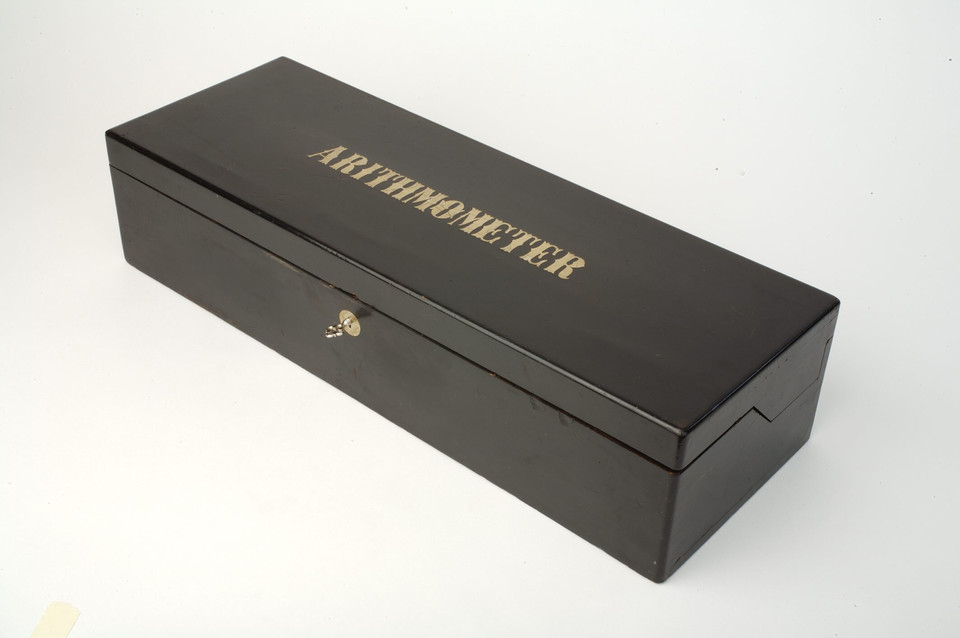
The mechanical engineer Curt Dietzschold (1852 - 1922) began in1876 in Glashütte with the development of a calculating machine that was to avoid the disadvantages of the Thomas design. He chose a setting and transmission principle in which a tooth engages in a gearwheel and rotates it according to the numerical setting. This switching method was later given the name "switching pawl principle" and was used very successfully in Hamann machines. From 1877 onwards, he had three samples made by Lange und Söhne, the whereabouts of some of which are known: one sample (with No. 3) is in the Mathematisch-Physikalischer Salon Dresden, a second (with No. 2) came to the Arithmeum in 2006 with the Waldbauer Collection; the third sample (probably with No. 1) could have been sent to the Prussian Statistical Office in Berlin in 1878.
In 1878 Dietzschold persuaded his fellow student Arthur Burkhardt to participate in the production of a calculating machine. But after Dietzschold was appointed head of the watchmaking school in Karlstein (Lower Austria) in 1879, Burkhardt changed the further development to the stepped drum principle according to Thomas, a decision that Dietzschold readily resented (Dietzschold [1882], p. 38-40). No further machines with Dietzschold's switching ratchet technology were built.
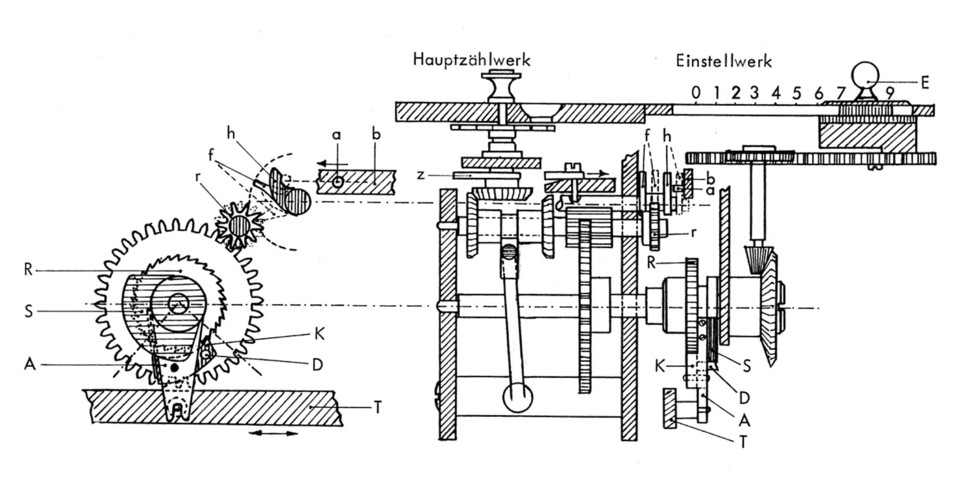
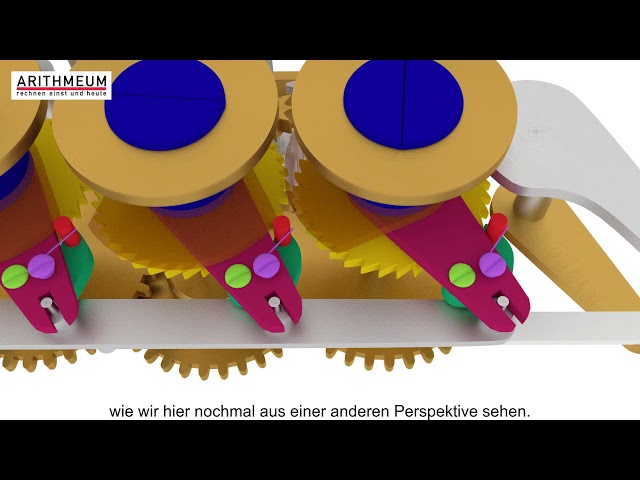
The essential switching function is performed by means of the ratchet K, which engages in the gear wheel R after pin D has left the steel sector S; as long as D slides on S, the ratchet is lifted out of the gear wheel. Sector S is swivelled via the rail T at an angle of 90° depending on the set number. Turning the crank sets the rail T in a back and forth motion. In doing so, it takes the ratchet K with it via A. When moving T to the right, the ratchet acts on R, when moving to the left, the ratchet slides over the teeth of R without turning them.
The machine can be regarded as an extremely valuable document of the initial spark of calculating machine production in Germany.
- Inventory number:
- FDM7153
- Year of invention:
- 1876
- Manufacturer:
- Lange und Söhne
- Year of manufacture:
- 1876
- Main category:
- Vierspeziesmaschine
- Subcategories:
- Schaltklinke
- Capacity:
- 8 (EW) x 8 (UZW) x 16 (RW)
- Dimensions (H x B x T):
- 17 x 48 x 12 cm
- Weight:
- 9,8 kg
- Serial number:
- 2
- Literature:
- Anthes, Erhard: „Die Rechenmaschine von C. Dietzschold – eine weitere frühe Schaltklinkenkonstruktion“, in: Historische Bürowelt 9, 1985, p. 21
- www.arithmeum.uni-bonn.de/sammlungen/rechenmaschinen-videos/archiv
- Dietzschold, Carl: „Die Rechenmaschine”, in: Allgemeines Journal der Uhrmacherkunst, 1882
- Lehmann, N. Joachim: Glashütte 1878. Beginn der deutschen Rechenmaschinenfertigung. Berlin 1989, p. 30-33
- Prinz, Ina: Die Funktion der Rechenmaschinen mit Schaltklinkenprinzip von Curt Dietzschold 1877 und von Friedrich Weiss 1893. In: Kulturstiftung der Länder - Patrimonia 353. Bonn 2010, p. 25-97
- Schillinger, Klaus: Rechengeräte aus der Sammlung des Mathematisch-Physikalischen Salons. Bestandskatalog. Staatliche Kunstsammlungen Dresden – Mathematisch-Physikalischer Salon Dresden/Zwinger. Dresden 2000, p. 46-48