






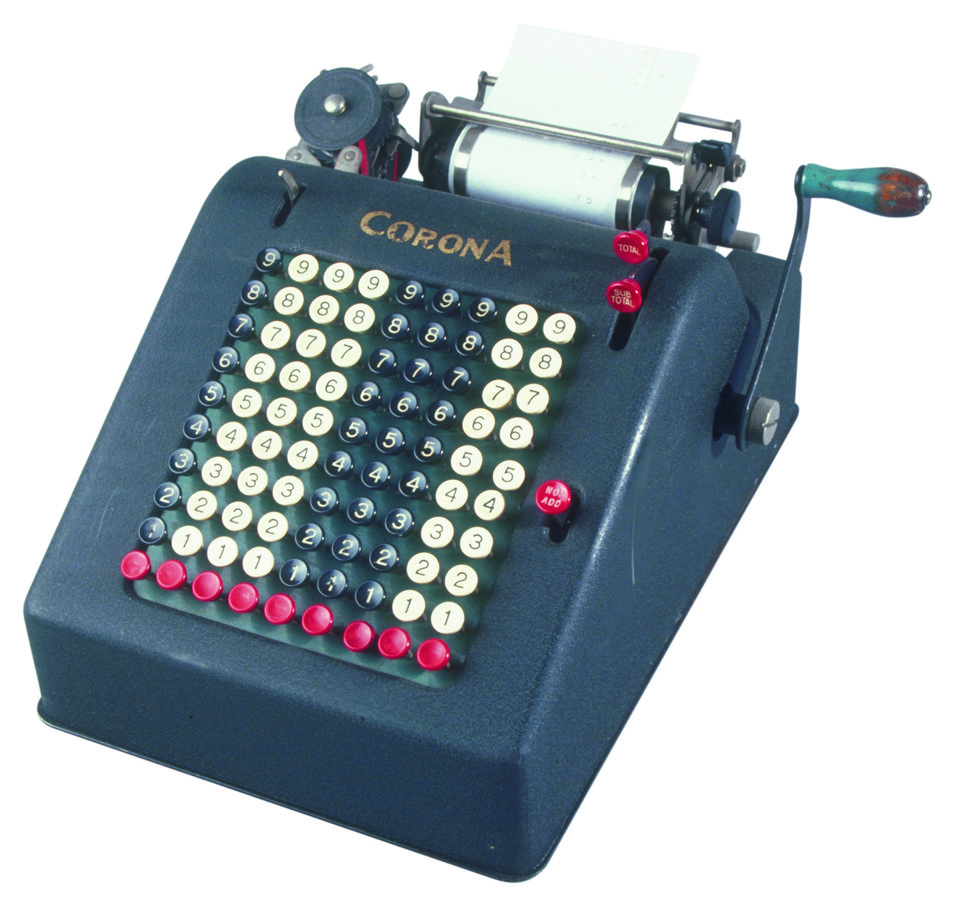
Corona 10 K "Portable"
Druckende Addiersegmentmaschine mit Volltastatur
ca. 1935
Corona 10 K "Portable"
Printing adder segment machine with full keyboard
ca. 1935
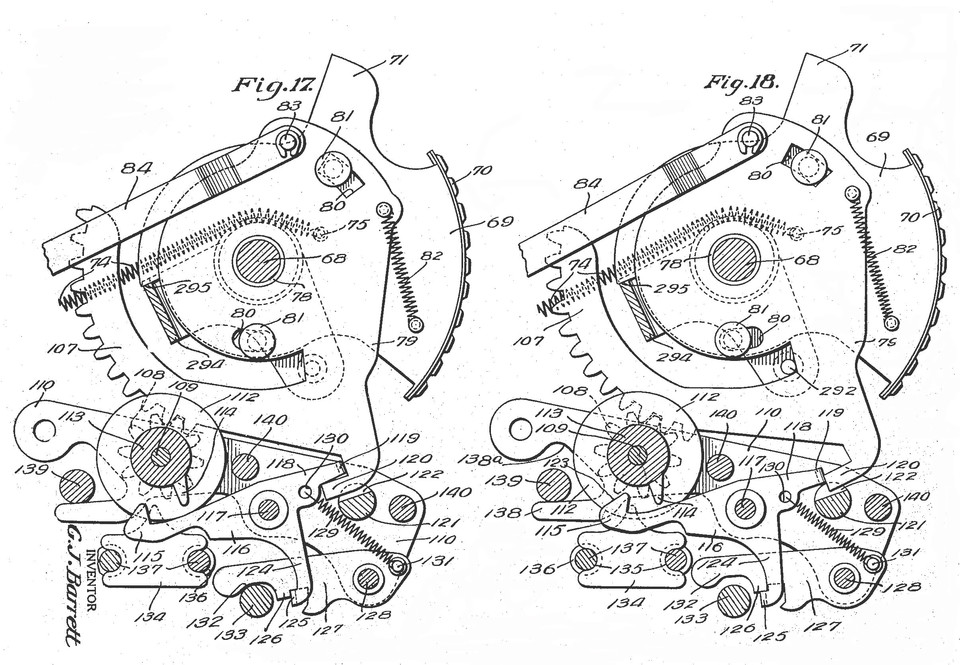
This adding machine was designed by Glen J. Barrett and manufactured starting in 1923 by the Portable Adding Machine Company in Chicago, a subsidiary of the Corona Typewriter Company. The primary argument for selling it was its low weight of just under 10 kg compared to Burroughs machines (approx. 30 kg). Furthermore, the price was also particularly attractive: at first, $75 was charged, then in 1927, only $60. With a list of 30 features, large advertisements praised the advantages of the machine, e.g., the complete visibility of what was printed or (somewhat strangely) its functionality at any temperature. Less tolerable might have been the notice: Unique method of subtraction. This obviously concealed the fact that the machine did not have a subtraction switch, i.e. it could not perform this type of calculation directly. It was necessary to use complementary arithmetic for this purpose, a method that works well but is somewhat cumbersome and, above all, takes some getting used to. The printing unit is to be regarded as a constructive characteristic of the machine: The two ribbon spools sit on a common axle on the left side of the pinch roller, which is pressed against the print types when the lever is pulled. Two functions each are, quite sparingly, placed on one lever: Subtotal and grand total, cancellation and repetition, a separate key is provided for non-addition. The Corona company manufactured adding machines until 1956.
- Inventory number:
- FDM6004
- Year of invention:
- 1933
- Manufacturer:
- Smith & Corona Typewriter Inc.
- Year of manufacture:
- ca. 1935
- Main category:
- Ein- bis Dreispeziesmaschine
- Subcategories:
- Addiersegment
- Capacity:
- 9 (EW) x 10 (RW)
- Dimensions (H x B x T):
- 20 x 28 x 38 cm
- Weight:
- 9,7 kg
- Production period:
- 1933 - 1946
- Serial number:
- K8 2E0136
- Literature:
- Brauner, Ludwig: Illustriertes Büromaschinen-Dauer-Lexikon. Berlin 1926, p. 25/45
- Kidwell, Peggy A.: „The Adding Machines of Chicago, 1884 – 1930“, in: Annals of the History of Computing, Juli/Sept. 2001, p. 3-21
- Martin, Ernst (Pseud.): Die Rechenmaschinen und ihre Entwicklungsgeschichte. Pappenheim 1925, Nachtrag 1936 (Nachdruck: Leopoldshöhe 1985), p. 356/409
- McCarthy, James H.: The American digest of business machines. Chicago 1924, p. 52
- Patents:
- US 1811840 [1925] (Glenn J. Barrett: Adding Machine)
- US 1812129 [1927] (Glenn J. Barrett: Calculating Mechanism for Adding and Listing Machines)
- US 1949445 [1932] (Glenn J. Barrett: Adding Machine)