






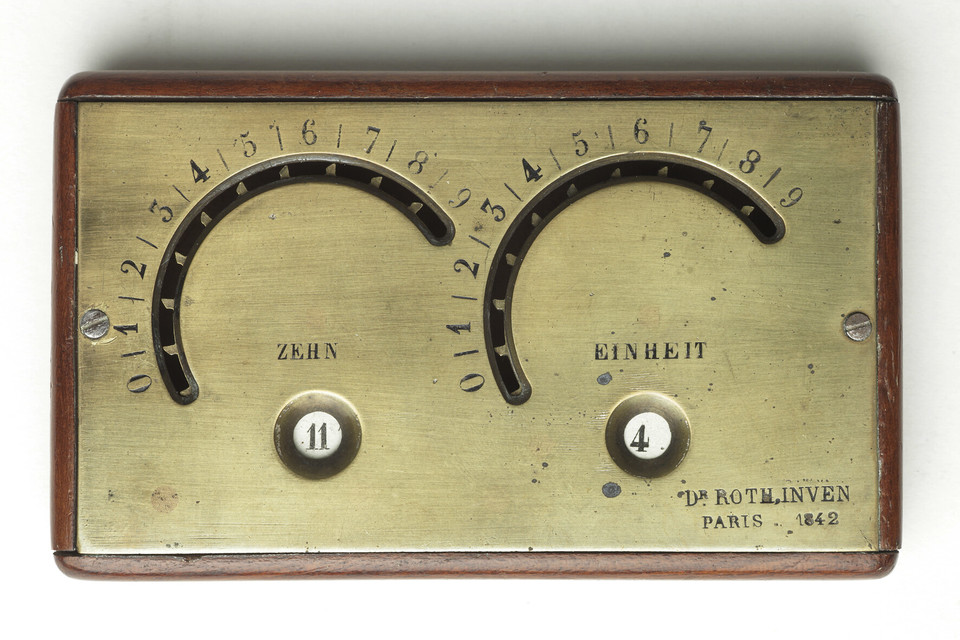
Roth Addiermaschine
Koplanare Zahnscheiben-Addiermaschine
1842
Roth adding machine
Coplanar toothed pulley adding machine
1842
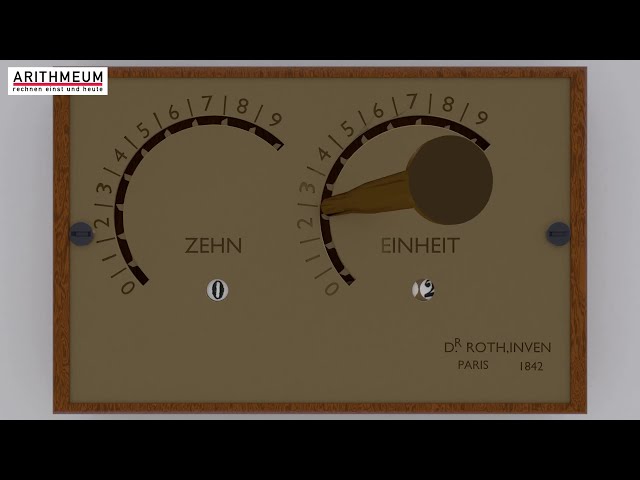
With this two-digit model of the adding machine by Didier Roth (1800-1885), it is easy to demonstrate how the ten-transfer works. At a time when the design of the decimal carry in calculating machines was often still the limiting factor for the number of digits in the machine, Didier Roth had an ingenious idea: he built a decimal carry in which force was stored which was then available when the machine was executed. For this purpose, he used a decentralized circular segment disk. This pushes the tens transmission lever, which is pressed by a spring in the direction of the shaft, further and further away from this shaft, the higher the set number is. If the number 9 is shown in the result mechanism, the carry-over lever has the greatest distance from the shaft and the spring is most strongly tensioned. During the transition from 9 to 0, the carry-over lever inside the machine slips over the edge of the circular segment disk and is pressed towards the shaft by the spring force. At this moment the other end of the angle lever reaches into the next higher position and pushes it one digit further. The ten-digit transfer thus works absolutely trouble-free over a large number of digits. The setting mechanism shows that each gear wheel of the calculator must have twice as many teeth as the setting mechanism, since exactly one half of a circle covers the digits 0 to 9. This means that the circular segment disk for the decimal transmission is also present twice on each shaft.
Roth built his addition machine in a small edition and later had it patented and sold by Wertheimber outside of France. Most of the original machines are in the Musée des Arts et Métiers in Paris. Individual pieces can be found in numerous technical collections worldwide. The Arithmeum owns an 8-digit adding machine by Roth from 1843 (FDM 7341) and a counting machine by Wertheimber (FDM 6096).
- Inventory number:
- FDM4220
- Inventor:
- Roth, Didier
- Year of invention:
- 1842
- Year of manufacture:
- 1842
- Main category:
- Ein- bis Dreispeziesmaschine
- Subcategories:
- Additionsmaschine
- Capacity:
- 2 (EW) x 3 (RW)
- Dimensions (H x B x T):
- 2 x 11 x 6 cm
- Weight:
- 128 grams
- Literature:
- Jacob, L.: Le calcul mécanique, appareils arithmétiques et algébriques intégrateurs. Paris 1911, p. 16-17
- Ocagne, M. de: Le calcul simplifié. Paris 1905, p. 61-62
- Patents:
- GB 9616 [1843] (Wertheimber: Calculating Machines, applicable to Wheel-Work)