






Braun Sprossenradmaschine (Replica)
Vierspezies-Sprossenradmaschine
1727
Braun stepped drum machine (replica): four-species stepped drum machine
1727
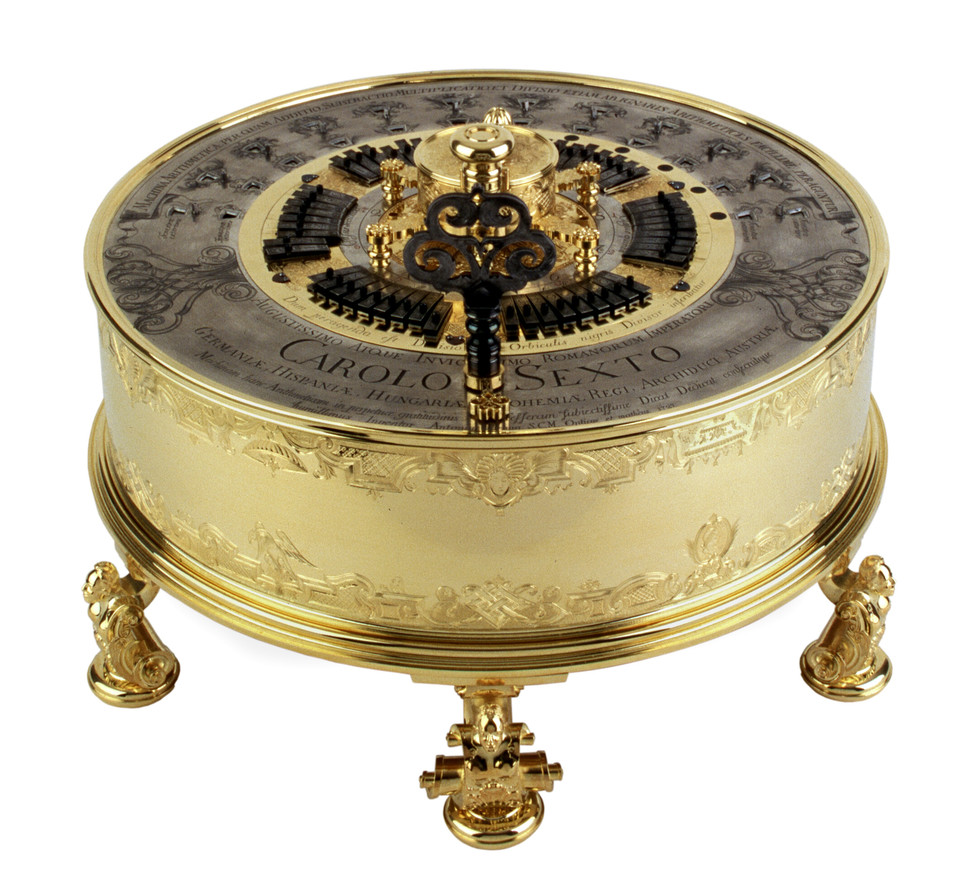
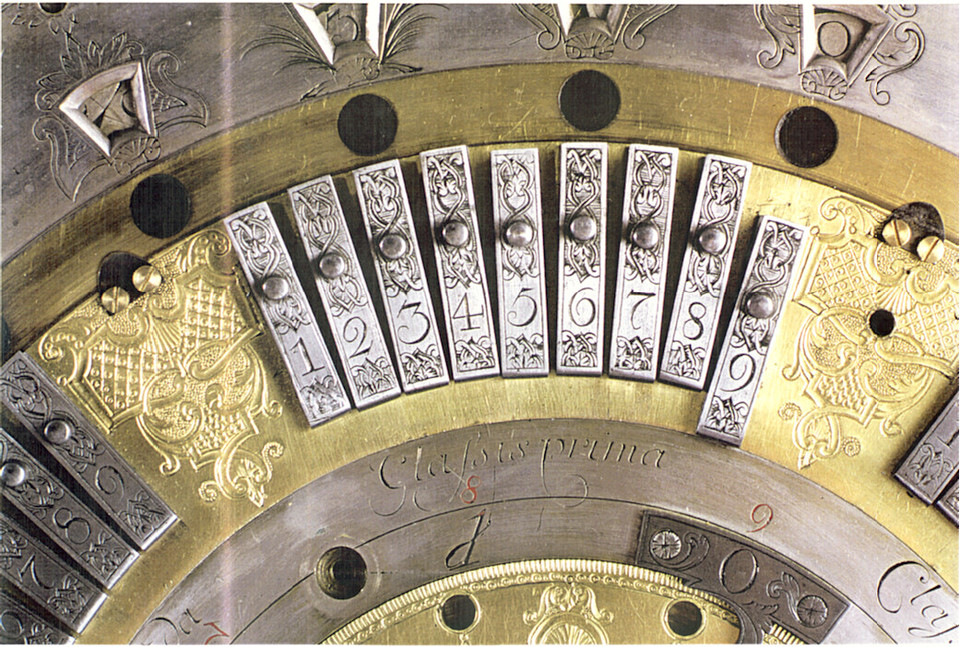
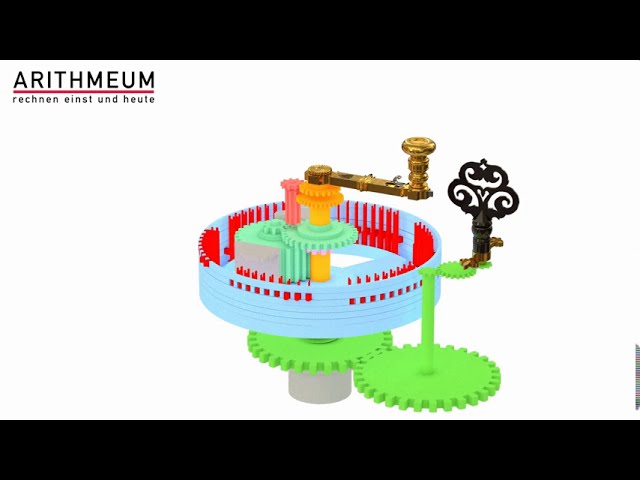
The mathematician and optician at the Viennese imperial court Anton Braun from Möhringen in the upper Danube valley presented a magnificently made reckoning machine to the emperor in 1727, with the purpose of supporting his position of the imperial instrument maker. He actually got the additional function, but died shortly afterwards. The six-digit setting mechanism is operated by the slides on the top surface, which are separated in six groups (digit values) with respectively nine slides (number values): The slides move single pins, so that for setting a number, for example 3, one has to move three slides in one group (they belong to one digit) radially outwards. When turning the crank, the required value is added in the result mechanism (twelve digits with complementary display); the result can be read in windows in the outer ring. The setting mechanism can be rotated in relation to the result mechanism, so that effective multiplication and division is possible. The machine has a single-digit revolution counter with a stop pin. This calculating machine was probably not used in everyday life, but rather as a curious display object of the treasury and miracle chamber of the imperial court. This can be concluded from the fact that handling the machine requires not only a good knowledge of the function of the machine, but also of its deficits. For example, the adjustment slides of the sprout wheels were not provided with a resting function in the 0-position, so that when the pins were moved in carelessly, they could fold into the inside of the pin wheel mechanism and could only be removed from there by a complicated opening of the machine. In addition, a special position of the pin wheel mechanism ha to be retraced by turning the key to ensure contact between the setting mechanism and the pin wheel mechanism. Thus, the large circular reckoning machine from Anton Braun can essentially be seen as a fascinating magnificent object in which the function of reckoning mechanically of all four bas arithmetic operations was largely guaranteed, but was dar from optimal. Johann Baptist Straub (1704 – 1784), who later worked as a famous Rococo sculptor in Munich, was also able to draw attention to himself as a young artist by designing the coat, feet and also the engravings on the top of the machine. The light and playful aspect of this reckoning machine décor was unique and groundbreaking: from an ornamental decoration to a creative, artistic individual design. The engravings were handmade by the master engraver Manfred Burkert. In the years 2000/2001, an exact replica of the machine was made by the employees of the Arithmeum Ullrich Wolff and Ingo Laubach as well as the training workshops of the Klöckner-Möller company in Bonn. The original is located in the art-historic museum in Vienna.
- Inventory number:
- FDM6677
- Inventor:
- Braun, Anton
- Year of invention:
- 1727
- Replica manufacturer:
- Ullrich Wolff, Arithmeum; Ingo Laubach, Arithmeum; Klöckner-Möller, Bonn; Manfred Burkert
- Replica year of manufacture:
- 2001
- Main category:
- Vierspeziesmaschine
- Subcategories:
- Sprossenrad
- Capacity:
- 6 (EW) x 1 (UZW) x 12 (RW)
- Dimensions (ø):
- ø 45 cm
- Weight:
- 29,5 kg
- Literature:
- Anthes, Erhard: „Zum 300. Geburtstag von Anton Braun (1686-1728) – Instrumentenmacher in Wien und Konstrukteur einer Rechenmaschine“, in: Historische Bürowelt 18, Juli 1987, p. 23-27
- Habacher, Maria: „Mathematische Instrumentenmacher, Mechaniker, Optiker und Uhrmacher im Dienste des Kaiserhofes in Wien (1630-1750)”, in: Blätter für Technikgeschichte 22, 1960, p. 4-80
- Nagler, Josef: „Beschreibung der Rechenmaschine des Antonius Braun“, in: Blätter für Technikgeschichte 22, 1960, p. 81-87
- Woeckel, Gerhard P.: „Die Anton Braun´sche Rechenmaschine in Wien (1727) und ihre Gehäuseverzierung durch Johann Baptist Straub“, in: Alte und moderne Kunst 18, 1973, p. 19-24