






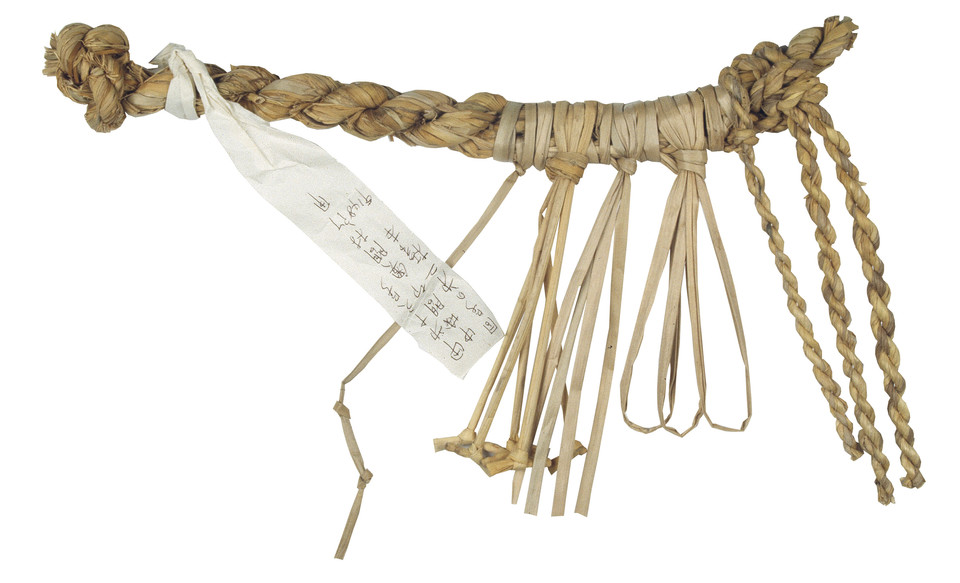
Warazan
Japanischer Datenspeicher aus Reisstroh
ca. 1600
Warazan
Japanese data memory made from rice straw
approx. 1600
Data was stored on the Japanese Ryukyu Islands with special knotted cords until the twentieth century. Knots made out of rice straw were arranged according to a certain system, representing quantities in the system of ten. This made it easy to record information even without knowing the characters.
A similar method is also known from the Inca Empire. There, the knotted cords (Quipu) were used for administrative records, with which religious, chronological and statistical data were stored. It was especially useful for bookkeeping to be able to follow the individual steps of calculations and intermediate results.
We are grateful to Professor Dr. Josef Kreiner, Japanologist at the Rheinische Friedrich-Wilhelms-University of Bonn, for providing these extremely rare objects.
- Inventory number:
- FDM6587
- Year of invention:
- ca. 1600
- Manufacturer:
- Einwohner von Okinawa
- Year of manufacture:
- ca. 1930
- Main category:
- Einfaches Rechenhilfsmittel
- Dimensions (H x B x T):
- 3 x 27 x 17 cm
- Weight:
- 27 grams
- Serial number:
- 9148