






Esser
Vierspezies-Sprossenradmaschine
1892
Esser
Four-species pinwheel machine
1892
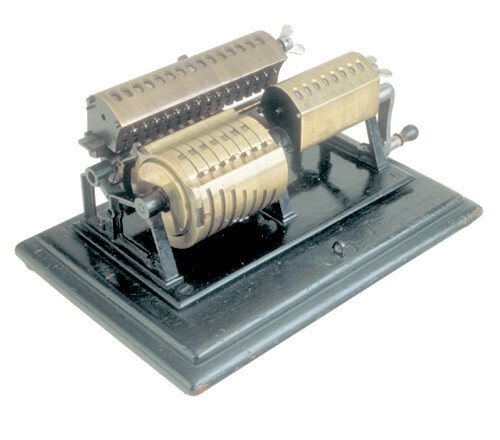
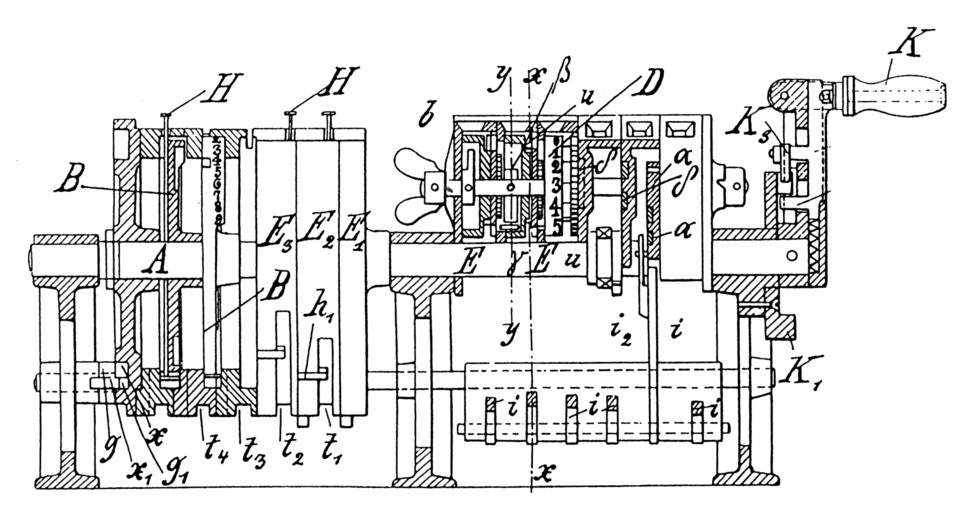
When Grimme, Natalis & Co. started production of the Brunsviga pinwheel machine in Braunschweig in 1892, Aachen civil engineer Heinrich Esser was given the DRP 82 965 on his calculating machine construction, which also uses the pinwheel as a transmission element. In the introduction to his patent specification, Esser mentions three particularly advantageous aspects of his machine: the convenient setting of numbers in the rear derailleur, the reliable tens transmission in the result mechanism, which he himself attributes to the switching mechanism, and the tens transmission in the revolution counter, the so-called divisor counter.
In the two previously known examples of this construction (first: Braunschweigisches Landesmuseum, capacity 6 x 8 x 14, second: Arithmeum, capacity 7 x 8 x 15) the adjustment is indeed somewhat more reliable than in the Brunsviga, which was released at the same time, because the adjustment levers can be set to clear detent positions in an easily accessible way and there is a visible adjustment control. However, both Esser machines - in contrast to what is described in the patent - do not have a tens transmission in the revolution counter, so the abbreviated multiplication described in the patent cannot be carried out with them. The Esser ten-transmission is solved differently than in the Odhner machines: With a simple lever construction, ten-transmission teeth are pulled out of the pin-carriers against a spring force, into which they plunge again after the transmission is completed. The machine is helical. For additive and subtractive calculation, the crank is moved in different directions of rotation; for each of the two directions of rotation, therefore, two sets of decimal transmission teeth are helically fitted. While the Odhner machines appear closed in their overall design, the Esser machine is clearly divided into a setting mechanism, revolution counter and calculating mechanism. The Esser machine was not manufactured in series.
- Inventory number:
- FDM6581
- Inventor:
- Esser, Heinrich
- Year of invention:
- 1892
- Year of manufacture:
- 1892
- Main category:
- Vierspeziesmaschine
- Subcategories:
- Sprossenrad
- Capacity:
- 7 (EW) x 15 (UZW) x 8 (RW)
- Dimensions (H x B x T):
- 15 x 33 x 22 cm
- Weight:
- 7,4 kg
- Serial number:
- A1
- Literature:
- Mehmke, R.: „Numerisches Rechnen“, in: Encyclopädie der mathematischen Wissenschaften. Leipzig 1902, Bd. 1, Teil 2, p. 938-1079, Bd. 1, Teil 2, p. 965-974
- Platen, Jürgen von: „Sprossenrad-Konstruktionen“, in: Büromaschinen-Mechaniker 78, 1965, p. 131-132
- Patents:
- DE 82965 (Heinrich Esser: Rechenmaschine)