







Schuster III
Vierspezies-Staffelwalzenmaschine
1820
Schuster III
Four-species stepped drum machine
1820
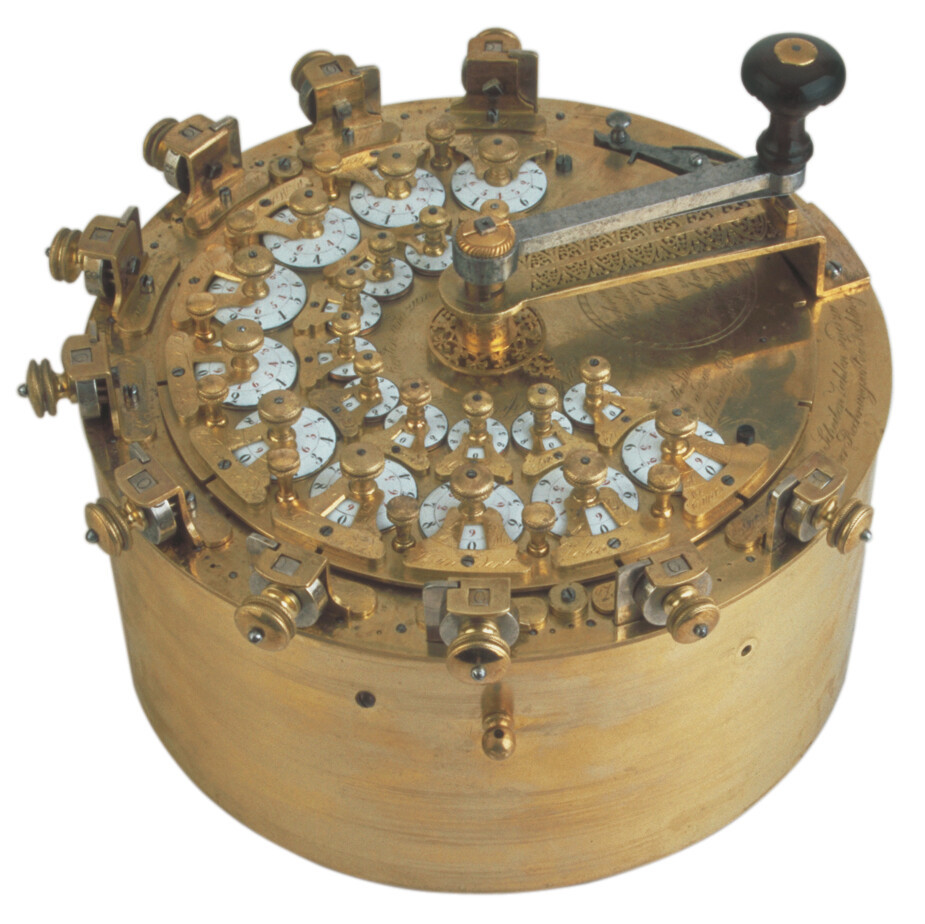
The Franconian watchmaker Johann Christoph Schuster (1759 - 1823) built three cylindrical calculating machines according to today's knowledge: The first one, with eleven digits and dated 1789-1792, still follows the exact design of the Hahn calculating machines (, also in outer appearance) and is preserved in the German Museum. The second, with nine digits, is dated 1805-1820, and is somewhat smaller than the first. Its' setting wheels of the setting mechanism are known from the Müller machine; the original is also in the German Museum in Munich, a replica in the Arithmeum (cf. Inv. No. FDM 6141). The ten-digit calculating machine discussed here was constructed in 1820/22, but did not become known until 1993 at an auction in London. In 1999, it became part of the collection of the Arithmeum. The machine is inscribed: "Calculation Maschine of Johann Christoph Schuster zu Ansbach in Franconia started in 1820 and finished in 1822". The ten digits of the setting mechanism are operated with knurled nuts, and the setting of a number can be checked through a control mechanism with number rollers. The result mechanism and the revolution counter are located in the central, rotating part of the machine; they each have ten digits. The larger enamelled dials belong to the result mechanism, the smaller ones to the revolution counter. The black and red digits in the result mechanism are intended for multiplication and division respectively. A corresponding inscription is located next to the unit place: "RothSubtr: u: Div: Black Add: u: Mult:" On the setting ring is engraved: "The disc numbers are the direction of the calculation type". The digit values of the result are engraved as follows: One, tens, hundred, thousand, 10 thousand, 100 thousand, million, 10 million, 100 million, 1000 million [= 1 billion]. Each of the two mechanisms has a direct setting method by means of knurled nuts; these also serve to delete the movement in question. The inner unit, which is rotatably adjusted for decimal movement, is fixed by means of a latch. The crank may only be turned in one direction (clockwise). The respective calculating position of the revolution counter is indicated by a pointer. The essential mechanical devices - including stepped drums and the two-stage tens transfers - correspond to those of Hahn's design. The machine was developed at a time when the Frenchman Charles Xavier Thomas made his first efforts to build a commercially usable stepped drum machine. It is probably the last artifact of the pre-industrial phase.
- Inventory number:
- FDM6564
- Inventor:
- Schuster, Johann Christoph
- Year of manufacture:
- 1820
- Main category:
- Vierspeziesmaschine
- Subcategories:
- Staffelwalze
- Capacity:
- 10 (EW) x 10 (UZW) x 10 (RW)
- Dimensions (H, ø):
- 19 cm, ø 23 cm
- Weight:
- 4,5 kg
- Literature:
- Anthes, Erhard: „Die Rechenmaschinen von Philipp Matthäus Hahn“, in: Hahn [1989], II, p. 456-478
- www.arithmeum.uni-bonn.de/sammlungen/rechenmaschinen-videos/archiv
- Kehrbaum, Annegret/Korte, Bernhard: Calculi: Bilder des Rechnens einst und heute. Katalog zu einer Ausstellung anläßlich der 25. Jahresfeier der Nordrhein-Westfälischen Akademie der Wissenschaften, Düsseldorf. Opladen 1995, p. 55-69
- Korte, Bernhard: Arithmeum - Die Rechenmaschine von Johann Christoph Schuster 1820/22. Kulturstiftung der Länder - Patrimonia 203. Bonn 2004
- Speckhart, Gustav: „Johann Christoph Schuster und Georg Matthias Burger, zwei Schüler des Pfarrers Hahn“, in: Deutsche Uhrmacher-Zeitung 6, 1906, p. 90-91