






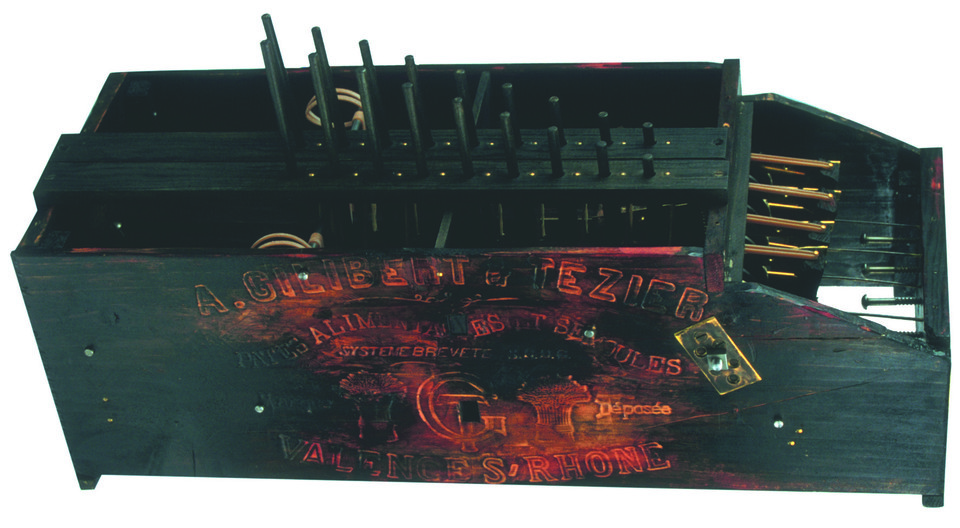
Comptometer Macaroni-Box (Replica)
Schaltschwingenmaschine: Replik des Versuchsmodells
1884
Comptometer Macaroni-Box (Replica)
Swing lever machine: replica of the test model
1884
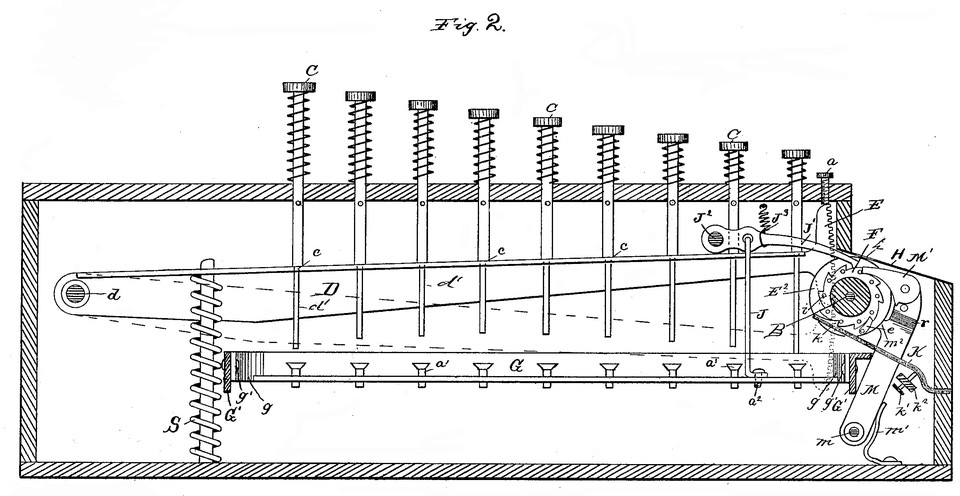
The first experimental model for the later Comptometer machines was built in Chicago in 1885 by Dorr Eugene Felt, who was only 23 years old at the time. It was a primitive mechanism consisting of the wood of a transport box for pasta (macaroni), metal strips from tin cans and some steel axles and rubber rings to generate restoring forces. On this device, Felt studied the motion sequences for the switching mechanism of a calculating machine. His findings were later used to create the very famous and widely used Comptometer. The original from 1885 is now in the National Museum of American History, Smithsonian Institution, Washington. The replica, which was built in 1996 in the workshop of the Research Institute for Discrete Mathematics, Bonn (Ullrich Wolff), was precisely modelled after the original. One position has been permanently installed and four more positions could be added. However, this was not done for the time being to give a better view of the mechanism. The case was made by an artisan from Bonn. Since no description has been found so far of how this device was operated by the inventor, one remains dependent on speculation. Above all, it is unclear how the machine was set up. In the way the Comptometer is set up, the result work is located directly in front of the keyboard. With the Macaroni box, this arrangement surprisingly results in a tens tranfer in the wrong direction, from left to right. So maybe Felt had set up the device back then so that the counter was behind the keyboard. However, this will impair the view of the register. The operation of this first model is basically the same as that of the machines that were later produced in series. The key shafts press down on the rocker arm, which with its toothed segment at the end turns the wheels of the result mechanism. The tensioned rubber rings lift the switching lever back to its original position. Further development brought additional devices that made the mechanical processes, especially for the transfer of tens, safer and the handling of the machine easier. The mechanics of the series machines were made entirely of metal, with the first 6500 machines still built into a wooden case ("Holzcomptometer", FDM 7645). Production of this first series began in 1887 and was replaced in 1903 by the first Model A in a metal case.
- Inventory number:
- FDM6282
- Inventor:
- Felt, Dorr E.
- Year of invention:
- 1884
- Manufacturer:
- Dorr Eugene Felt (1862 - 1930)
- Year of manufacture:
- 1885
- Replica manufacturer:
- Arithmeum, Ulrich Wolff
- Replica year of manufacture:
- 1996
- Main category:
- Ein- bis Dreispeziesmaschine
- Subcategories:
- Schaltschwinge
- Capacity:
- 5 (EW) x 5 (RW)
- Dimensions (H x B x T):
- 28 x 23 x 25 cm
- Weight:
- 4,2 kg
- Production period:
- 1884 - 1885
- Literature:
- Turck, J. A. V. [1921]: Origin of Modern Calculating Machines. A Chronicle of the Evolution of the Principles that form the Generic Make-up of the Modern Calculating Machine. Chicago 1921, p. 50
- Patents:
- US 366945 [1886] (Dorr E. Felt: Adding Machine)
- US 371496 [1887] (Felt & Tarrant: Adding-Machine)
- US 396034 [1887] (Dorr E. Felt: Adding-Machine)