






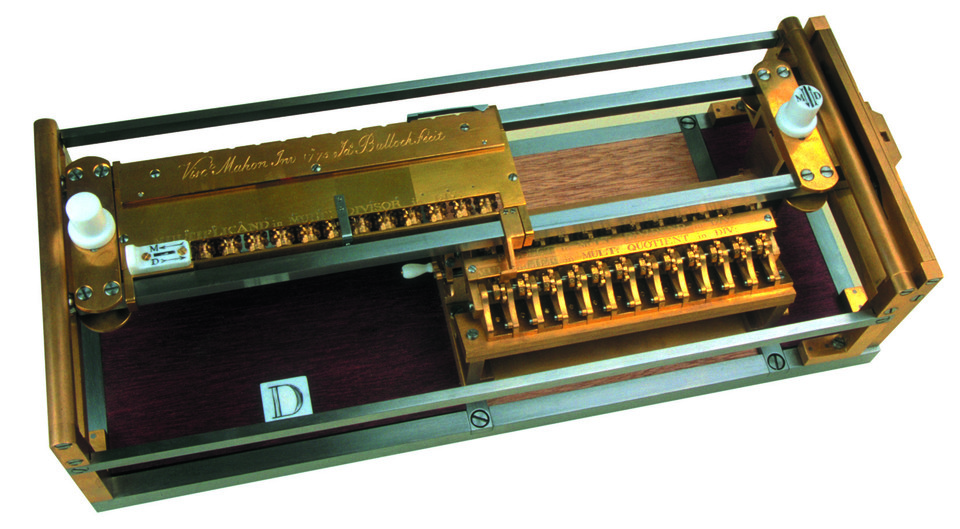
Stanhope Staffelwalzenmaschine (Replica)
Vierspezies-Staffelwalzenmaschine
1775
Stanhope stepped drum machine (replica): four-species stepped drum machine
1775
Charles Third Earl of Stanhope (1753 – 1816) constructed the first of three calculating machines in 1775. As an engineer, writer, scientist and politician, the invention of a reckoning machine was very important to him, because it had a constructed and scientific aspect. Nevertheless, it also was of service for him in a descriptive way as a politician to calculate Great Britain’s public dept in the House of Commons. All three calculating machines worked differently. The last one was only an adding machine. The calculator from 1775 is special in its construction.
Stanhope used a metal cylinder, which has 0-9 teeth lengthwise, for the mechanical number memory. If a number is set on the 12-digit setting mechanism by rotating the cylinders, one can read this off in the setting control mechanism and the according number of teeth point down to the takeover gears of the result mechanism. These are arranged parallel on one shaft and be seen openly. In the case of multiplication, the user pulls the setting carriage horizontally towards him and the pushes it back again. On the way there, the set number will be transferred in the result mechanism, on the way back, the prepared tens carries will be executed. Before the multiplication, the according multiplier is set at the respective digit, since the mechanism, which counts the number of pushing processes, can only subtract. If 0 appears there, the multiplication process is complete. This has the advantage that this mechanism can count additively in the subtraction or division and the result can be read of there. For subtraction, a lateral attached rocker lever is moved, until a D is seen in the window on the right instead of the M for multiplication. Now the control switches are turned for the carriage mechanism, so that the cylinders of the result mechanism can only be rotated in the opposite direction during the push-back movement. The disadvantage of this directional decision consists in the fact that the tens carries are executed on the way there and the tens carries, that accrued during the reckoning process, cannot be executed in the same reckoning step. To avoid this problem, Stanhope inserted a small white crank in the side of the result mechanism, with which any outstanding tens carry at the end of a subtraction or division can be executed. Stanhope had planned a digital shift to realize multiplications with multi-digit multiplicands and to simplify the division. For this purpose, the setting carriage was moved to the left by respectively many digits.
The materials are brass, steel, ivory and mahogany. In 1996, the replica was modeled exactly on the original machine of the London Science Museum and is now fully functional.
- Inventory number:
- FDM6281
- Inventor:
- Stanhope, Charles Viscount Mahon, 3rd Earl of
- Year of invention:
- 1775
- Manufacturer:
- James Bullock
- Replica manufacturer:
- Ullrich Wolff, Arithmeum; Ivan Iwanoff, München
- Replica year of manufacture:
- 1996
- Main category:
- Vierspeziesmaschine
- Subcategories:
- Staffelwalze
- Capacity:
- 12 (EW) x 12 (UZW) x 12 (RW)
- Dimensions (H x B x T):
- 12 x 46 x 18 cm
- Weight:
- 9,4 kg
- Literature:
- Ligonnière, Robert: Préhistoire et histoire des ordinateurs, des origines du calcul aux premiers calculateurs électroniques. Paris 1987, p. 51-54