






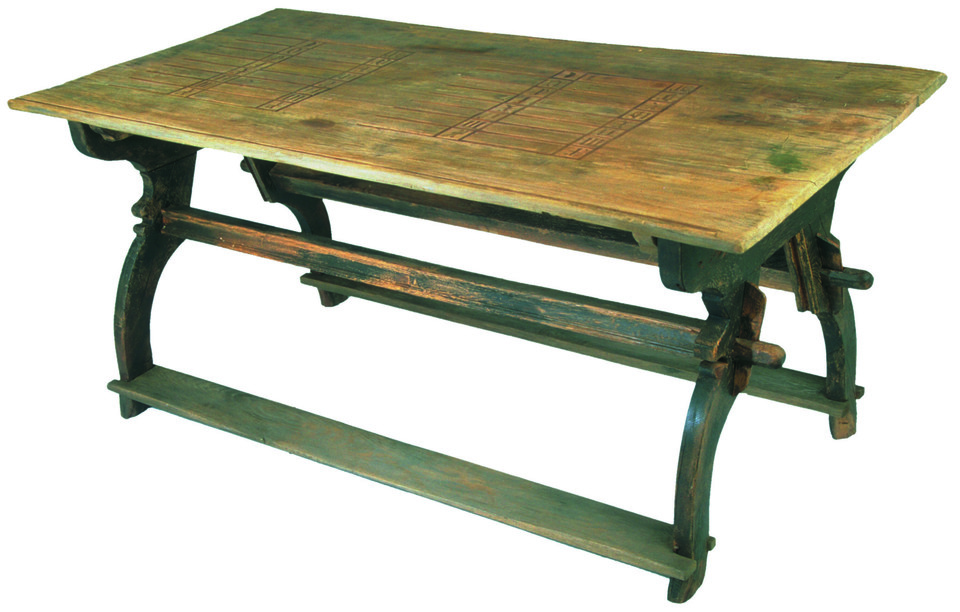

Rechentisch (Replica)
Mittelalterliches Rechenbrett mit Liniensystem für zwei Währungen
1500
Reckoning table (Replica)
Medieval calculating board with line system for two currencies
300 B.C.
Many preserved calculating tables and sheets show names for currency units before the columns. On the Dinkelsbühler calculating table, the guilder and the older pound currency are opposite of each other. Both were in use in the western Franconia in the 15th century. The spaces between the calculating tables then became so-called coin strips. This means that the space in between represents the units, while the lines represent bundles of five.
The "calculating on the lines" works like this: If you place placeholders, small calculating pennies, on these lines, they represent the value of the respective place. For a simple calculating table without further currency division, one arithmetic penny on the bottom line corresponds to "1", two arithmetic pennies on the bottom line to "2", three to "3", and so on. On the line above, however, one arithmetic penny corresponds to the number "10", two to "20", three to "30", and so on. On the third line from the bottom are accordingly the hundreds, then on the next line the thousands and so on. In the spaces between the lines, the arithmetic penny is five times the value of the line below.
The "calculating on the lines" was not replaced by "calculating with the pen" until the 15th century in Western Europe. The early German arithmetic books provide information about this. They were the first printed cultural documents in German alongside religious texts. There, calculating at the calculating table is usually treated in detail. Progressive Reckoning Masters of the time compared it to"calculating with a pen", i.e. written arithmetic with Indian-Arabic numerals which were newly introduced at that time. This proves that "calculating on the lines" was the predominant way of calculating in Europe for at least 1800 years.
As common and successful as "calculating on the lines" was, it was not a very fast calculating aid. However, it was an important aid for calculating with Roman numbers, since the numbers on the lines could be read directly as a Roman number even when the number of fives was bundled.
- Inventory number:
- FDM6259
- Year of invention:
- vor 1500
- Main category:
- Einfaches Rechenhilfsmittel
- Dimensions (H x B x T):
- 80 x 175 x 86 cm
- Literature:
- Becker, Gerhard: Das Rechnen mit Münze, Maß und Gewicht seit Adam Ries. Materialien & Studien zu Alltagsgeschichte und Volkskultur Niedersachsen, H. 21. Cloppenburg 1994, p. 383-384
- Hess, Wolfgang: „Rechnung legen auf den Linien, Rechenbrett und Zahltisch in der Verwaltungspraxis in Spätmittelalter und Neuzeit“, in: Maschke, E./Sydow, J. (Hrsg.): Städtisches Haushalts- und Rechnungswesen. Sigmaringen 1977, p. 69-82, p. 172-173
- Menninger, K.: Zahlwort und Ziffer. Göttingen 1958, II, p. 153ff.