






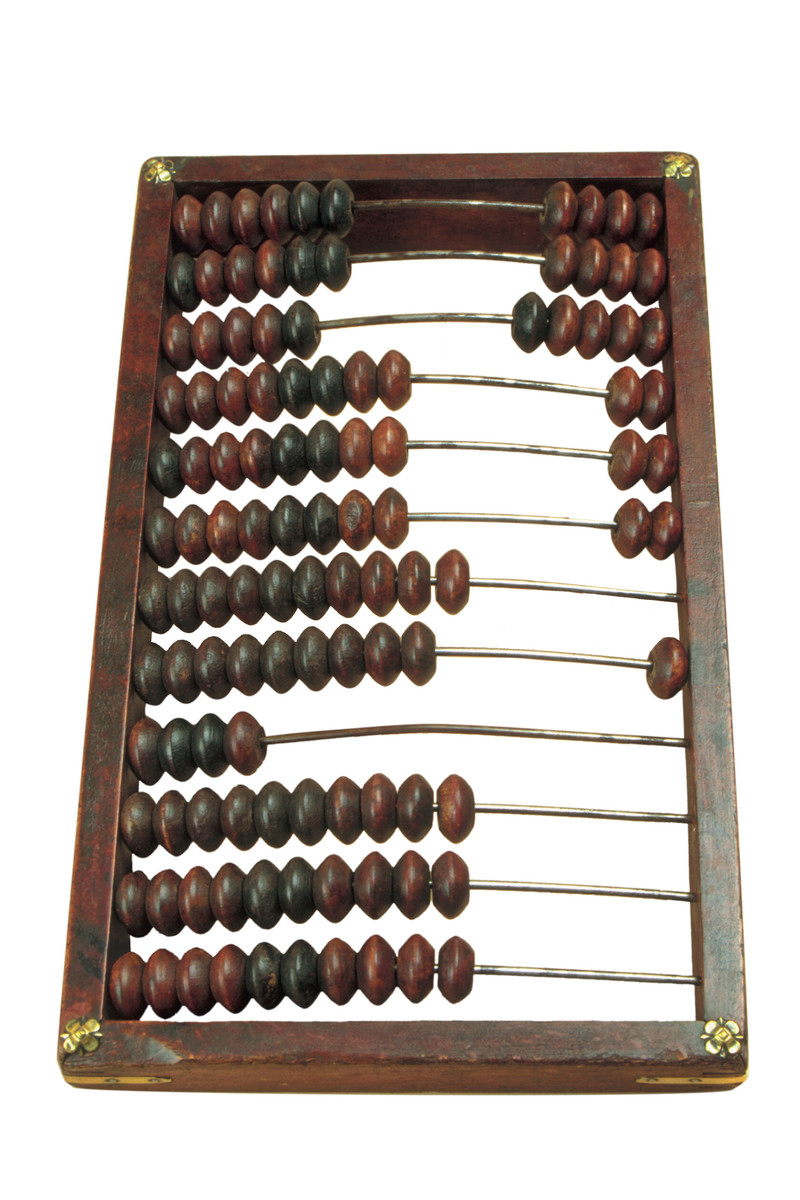
Stschoty
Russischer Abakus
ca. 1700
Stschoty: Russian abacus
around 1700
The Stschoty is a Russian reckoning board, which is made of wooden frame with cross bars – their number matches the digits. The word Stschoty is derived from the Russian Stschot (reckoning). The Stschoty is used by sliding the balls on the crossing bars horizontally from left to right and vice versa. In the basic position, all balls are on the right side of the frame. The result can be read off the left side. In Russia, they give up the bisection of the abacus. The grouping of 5, as seen at the Roman, Japanese (Soroban) or Chinese (Suanpan) abacus, is dropped. On each bar of the Stschoty are ten balls, where the fifth and sixth one have a different color; these color-coded balls are used as an optical memory aid to capture groups of fives during reckoning for example. Another characteristic of this realization of a reckoning board lays in the horizontal usage. Most boards are skewed like a desk, where the smallest digit is faced to the user. Furthermore, the bars show a little convex bulge to keep the balls at their position on the left or right side during the reckoning. In most cases, the first and fourth digits only have four balls. On one hand, this feature is conducive for displaying ¼ values (currency, weights and dimensions). On the other hand, it symbolizes the decimal point in a reckoning, when the balls on the bars don’t have a meaning. That means that all balls on the bars above have whole values in increasing potencies of tens and all balls on the lower bars have values in decreasing potencies of tens. In general, the usage of the Russian ball-computer is easier than the one of the Soroban or Suanpan. At the same time, it is slower. The version, which was used in the European area, was brought to Europe from a Russian expedition by the officer and mathematics professor Jean-Victor Poncelet (1788-1867) and became known as a school abacus. This Stotschy from the 20th century is made out of 12 rows of balls in a mortised wooden frame with four rosette-shaped corner nails. In the fourth row, there are only four of the otherwise tens used balls. This serves for reckoning with ¼-rubels or the displaying of the decimal digit.
- Inventory number:
- FDM6157
- Year of invention:
- ca. 1700
- Year of manufacture:
- ca. 1950
- Main category:
- Einfaches Rechenhilfsmittel
- Subcategories:
- Abakus, Stschoty
- Capacity:
- 12 (EW)
- Dimensions (H x B x T):
- 46 x 27 x 8 cm
- Weight:
- 1,5 kg
- Serial number:
- 205