






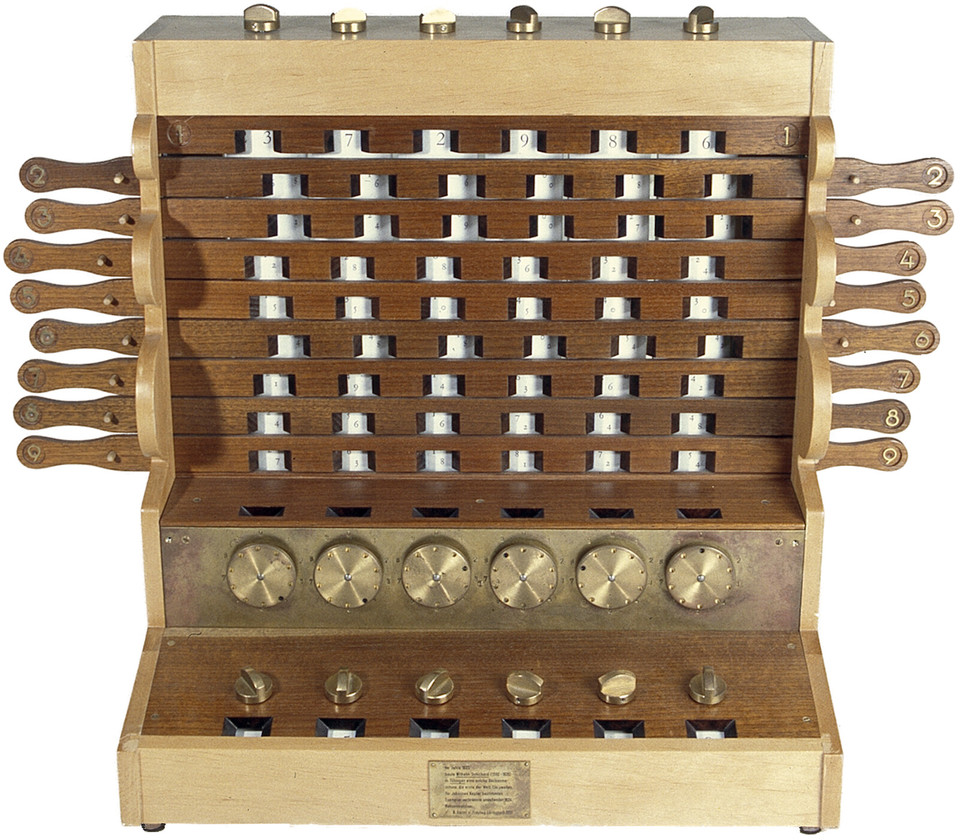
Schickard (Replica)
Zweispezies-Rechenmaschine
1623
Schickard (Replica)
Two-species calculating machine
approx. 1623
In 1623, Professor Wilhelm Schickard (1592-1635) from Tübingen constructed the world's first calculating machine with a mechanical tens carry.
As a mathematician, geodesist and astronomer, Schickard was interested in the possibility of error-free and reliable calculations.
He therefore invented a calculating machine of which he built two copies - one for himself and the other for his friend, the astronomer Johannes Kepler.
As both copies were lost in the Thirty Year War, it was for a long time unknown how the machines were built exactly.
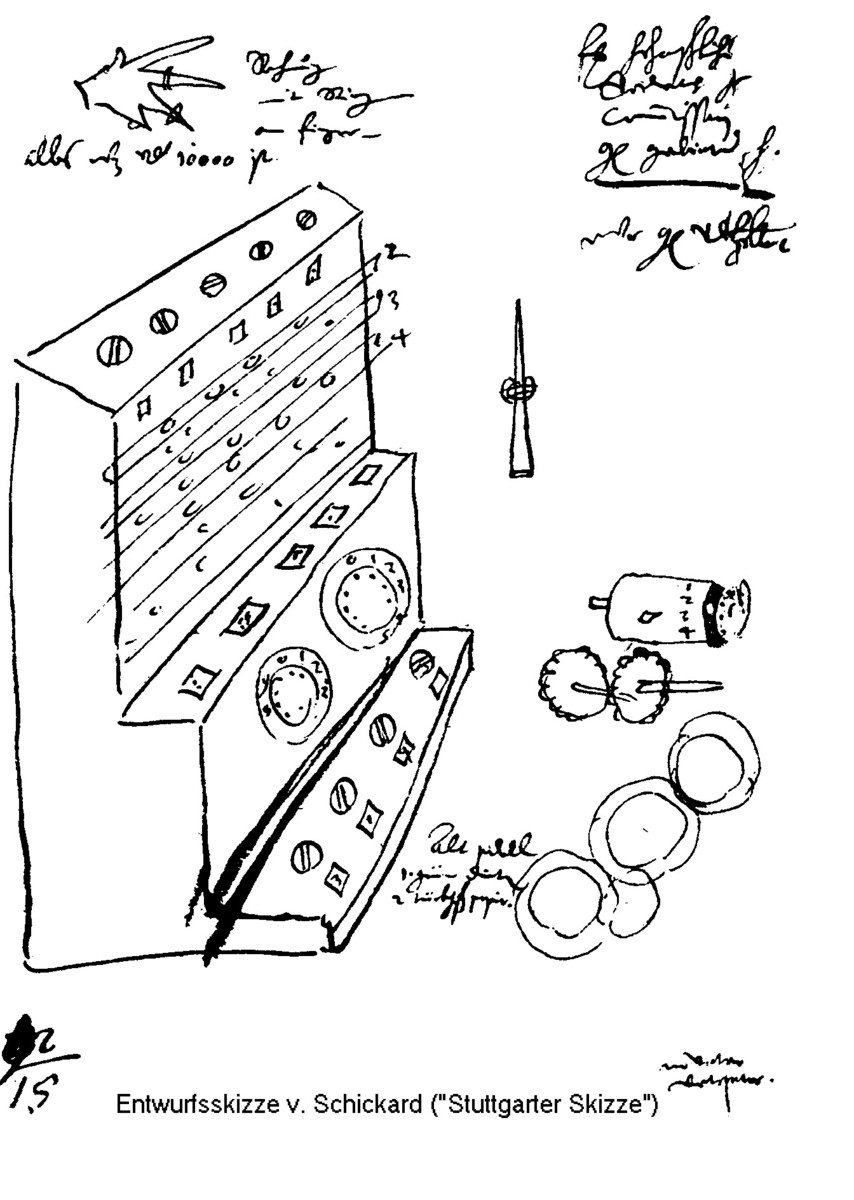
It was not until the 20th century that a detailed reconstruction could be achieved by bringing together descriptive texts and sketches that Schickard had sent to Kepler.
The initiative for this was taken by Professor Baron v. Freytag Löringhoff from Tübingen, who also made this reconstruction for the Arithmeum.
The machine consists of two parts: a lower part for addition and subtraction (consisting of a gear box with automatic tens carry) and an upper part for multiplication
and division (consisting of a modified version of Napier's rods in the form of six rotating cylinders - similar to the arrangement in a Schott calculating box).
A memory mechanism can be used as a revolution counter.
Since only the addition and subtraction mechanism has an automatic tens carry, the Schickard machine is the first mechanically functioning two-species calculating machine.
The other two basic arithmetic operations (multiplication and division) can be performed very easily by hand in conjunction with the two-species machine and the memorizing mechanism.
- Inventory number:
- FDM8205
- Inventor:
- Schickard, Wilhelm
- Year of invention:
- 1623
- Replica manufacturer:
- Professor Baron v. Freytag Löringhoff
- Replica year of manufacture:
- 1982
- Main category:
- Ein- bis Dreispeziesmaschine
- Capacity:
- 6 (EW) x 6 (UZW) x 6 (RW)
- Dimensions (H x B x T):
- 60 x 77 x 37 cm
- Weight:
- 18,4 kg
- Literature:
- Chase, G. C.: History of Mechanical Computing Machinery. Pittsburg 1952 (ergänzter Nachdruck: Annals of the History of Computing, 2, 1980, p. 198-226)
- Freytag Löringhoff, Baron B. von: „Wilhelm Schickard und seine Rechenmaschine von 1623“, in: Graef, M. (Hrsg.): 350 Jahre Rechenmaschinen. München 1973, p. 11-20
- Freytag Löringhoff, Baron B. von: „Die Rechenmaschine“, in: Seck, F. (Hrsg.): Wilhelm Schickard. Tübingen 1978, p. 288-309
- McCarthy, James H.: The American digest of business machines. Chicago 1924, p. 540